The Retention System Behind a DTC Brand's Growth From $131K to $2.4M/Month
The retention system, the 90-day build, and the frozen measurement rules behind a DTC brand's growth from $131,796.75 in September 2024 to $2,410,437.22 in the Nov 20 to Dec 20, 2024 window. Store revenue and attributed email plus SMS revenue are shown as two separate, clearly labeled results.
- Store platform revenue
- Hiro attribution, one-day interaction windows
- Client shown only as DTC Brand
This DTC Brand already had a strong product, proven demand, and an experienced operating team. What it didn't have was a retention system built to match. Email was underbuilt, SMS wasn't contributing meaningful revenue, and campaigns, flows, offers, segmentation, and reporting weren't operating as one program.
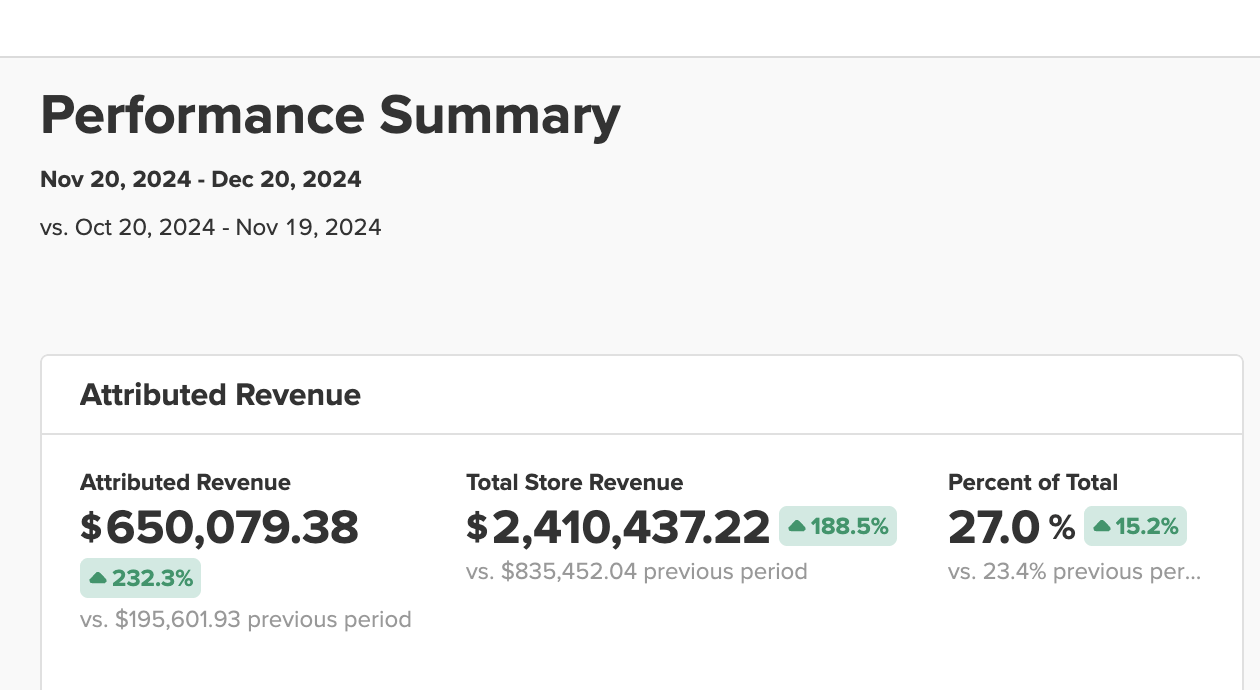
Over roughly 90 days, ZHS Ecom rebuilt that system from the ground up: offers, list growth, campaigns, lifecycle automation, segmentation, SMS, reporting, and full channel ownership under one accountable operator. Two results came out of that rebuild, and this page keeps them separate on purpose. Total store revenue moved from $131,796.75 to $2,410,437.22. Attributed email and SMS revenue moved from $195,601.93 to $650,079.38 in the adjacent 30-day comparison.
Below is the operating system behind the work, what the results do and don't prove, the exact measurement rules behind every figure, and a self-audit and 90-day planning template you can apply to your own brand.
Total store revenue, compared across roughly 90 days.
The headline compares total store revenue from the store platform. It is not a claim that email and SMS produced every dollar of the growth. Store revenue reflects the whole business, including acquisition, merchandising, seasonality, inventory, and conversion. The next sections separate the store result from the revenue attributed to email and SMS.
The before and after scorecard
Business result: total store revenue, September 2024 versus the Nov 20 to Dec 20, 2024 window, roughly 90 days apart. Retention result: attributed email and SMS revenue, compared across two adjacent 30-day windows, Oct 20 to Nov 19 against Nov 20 to Dec 20. These are two different measurements on two different timelines, and they are never blended into one number.
Flow plus campaign and email plus SMS are two ways of dividing the same attributed total. Do not add those component groups together. Use the attributed total once, then read the component rows to see where it came from. These are attributed figures, not incremental revenue, and they are never added to store revenue.
The attribution behind those figures is one day after an email open, one day after an email click, one day after an SMS delivery, and one day after an SMS click. Apple Mail Privacy Protection opens, bot clicks, and transactional messages are excluded. Every channel figure stays attached to that configuration and those exact 30-day windows.
What this result does and does not prove
The final window includes BFCM and peak holiday demand, so part of that store-revenue jump reflects seasonality, not just the retention rebuild. Total store revenue also reflects acquisition, merchandising, inventory, and conversion, none of which ZHS controls.
What this page claims is narrower and fully sourced: the systems ZHS built, and the frozen attributed figures above, under the exact windows and attribution settings disclosed below. It does not claim retention alone produced the full store-revenue increase, and it is not a guarantee that any $131K brand reaches $2.4M on the same timeline.
Who this applies to
This case fits a specific starting point: an established product with proven demand, a retention program that hasn't kept pace with the rest of the business, and an operator who wants one accountable partner instead of managing disconnected vendors or gaps in-house.
It is not evidence that retention alone turns any $131K brand into a $2.4M one. Paid acquisition, product-market fit, and the rest of the business still have to hold up. What this system reliably does is capture more of the value that demand is already creating.
The starting constraint
This DTC Brand did not need a new product or a first wave of demand. It needed retention execution that matched the quality of the business.
The opportunity sat behind the first purchase. Visitors were not being captured and monetized through a complete lifecycle system. Campaigns, flows, segmentation, offers, and SMS were not operating as one coordinated program. That left revenue uncaptured and limited the economics supporting paid acquisition.
The brand also wanted operational relief. Instead of managing several disconnected vendors or filling channel gaps internally, the operators wanted one partner to own the strategy, build, send calendar, monitoring, and reporting.
Stated plainly: strong demand was reaching an underbuilt retention system, so the brand was not capturing the full value of the traffic and customers it already had. What had to change:
- Create offers that increased conversion and order value without relying on undirected discounting.
- Capture more qualified visitors through brand-matched forms.
- Build a campaign cadence that could increase volume without sending every message to the full list.
- Install the lifecycle flows required to convert, recover, and retain customers automatically.
- Turn SMS into a coordinated channel rather than a disconnected broadcast tool.
- Give the brand one accountable retention owner and a measurement system it could trust.
The first 90 days
The sequence below explains how the program matured without assigning unsupported month-level revenue claims. Dated implementation records support the operating sequence. The approved numerical endpoint is the final store window and the adjacent channel comparison.
- Month 1
Establish control
Create visibility, ownership, and the first complete execution plan.
Core work- Baseline measurement
- List-capture planning
- Campaign calendar
- Segmentation rules
- Flow priorities
- SMS rollout
ResultNo standalone public revenue claim is made for this phase.
EvidenceDated setup, planning, and implementation records.
- Month 2
Build repeatability
Turn isolated wins into a repeatable retention cadence.
Core work- Segmented campaigns
- Offer testing
- Flow expansion
- List-capture refinement
- Coordinated email and SMS sends
ResultNo standalone public revenue claim is made for this phase.
EvidenceDated campaign, flow, offer, and channel records.
- Month 3
Scale what worked
Increase productive volume while protecting relevance and measurement quality.
Core work- Higher campaign throughput
- Stronger segmentation
- Flow optimization
- Offer iteration
- End-to-end reporting
ResultStore revenue reached $2,410,437.22 in the Nov 20 to Dec 20 window. Attribution credited $650,079.38 to email and SMS in that same window under the configured one-day interaction settings.
EvidenceStore platform source, attributed performance summary, and attribution settings.
Store revenue, attributed revenue, and each source system stay separate. They are never blended into one trend line or total.
Everything ZHS built
The result came from a coordinated retention system. Each component had a clear job and shared the same offer, audience, calendar, and measurement logic. The three diagrams below are anonymized reconstructions of that system, built from the verified case-study record, not raw client screenshots.
Offer and campaign engine
How a single offer decision reaches every channel on the same day.
- Offer strategy
- Segmented campaign cadence
- Coordinated email + SMS send
- Reporting and review
Lifecycle map
The priority flows running behind every customer journey stage.
- Welcome
- Cart / checkout / browse / site abandonment
- Post-purchase
- VIP
- Winback / sunset
Ownership loop
The weekly cycle that kept the system accountable to one owner.
- Measurement
- Planning
- Build / send
- Monitor
- Iterate
Offer strategy
Tiered offers, bundles, unlocks, dedicated landing destinations, and coordinated promotion.
Why it matteredGave customers a stronger reason to buy more while protecting the brand from undirected discounting.
List growth
Brand-matched forms and entry points tied to the campaign and lifecycle plan.
Why it matteredConverted more paid and organic traffic into owned audiences the brand could reach again.
Campaign engine
A consistent calendar, creative and copy production, offer sequencing, segmentation, sending, and review.
Why it matteredIncreased productive communication without treating the entire list as one audience.
Lifecycle automation
Welcome, checkout recovery, browse and site abandonment, post-purchase, and other priority flows.
Why it matteredCreated relevant next steps across the customer journey and recovered revenue automatically.
SMS program
Acquisition, campaign coordination, segmentation, and lifecycle messages.
Why it matteredAdded a second owned channel with a distinct role instead of duplicating every email.
Measurement and ownership
Reporting, monitoring, iteration, and one accountable channel owner.
Why it matteredLet the brand evaluate the program without running daily execution.
The evidence
The page shows the real work, not decorative imagery. The two anonymized captures on this page are the approved proof for this release: the attributed performance summary shown above, and the attribution configuration below. Neither can support any claim beyond the frozen figures on this page.
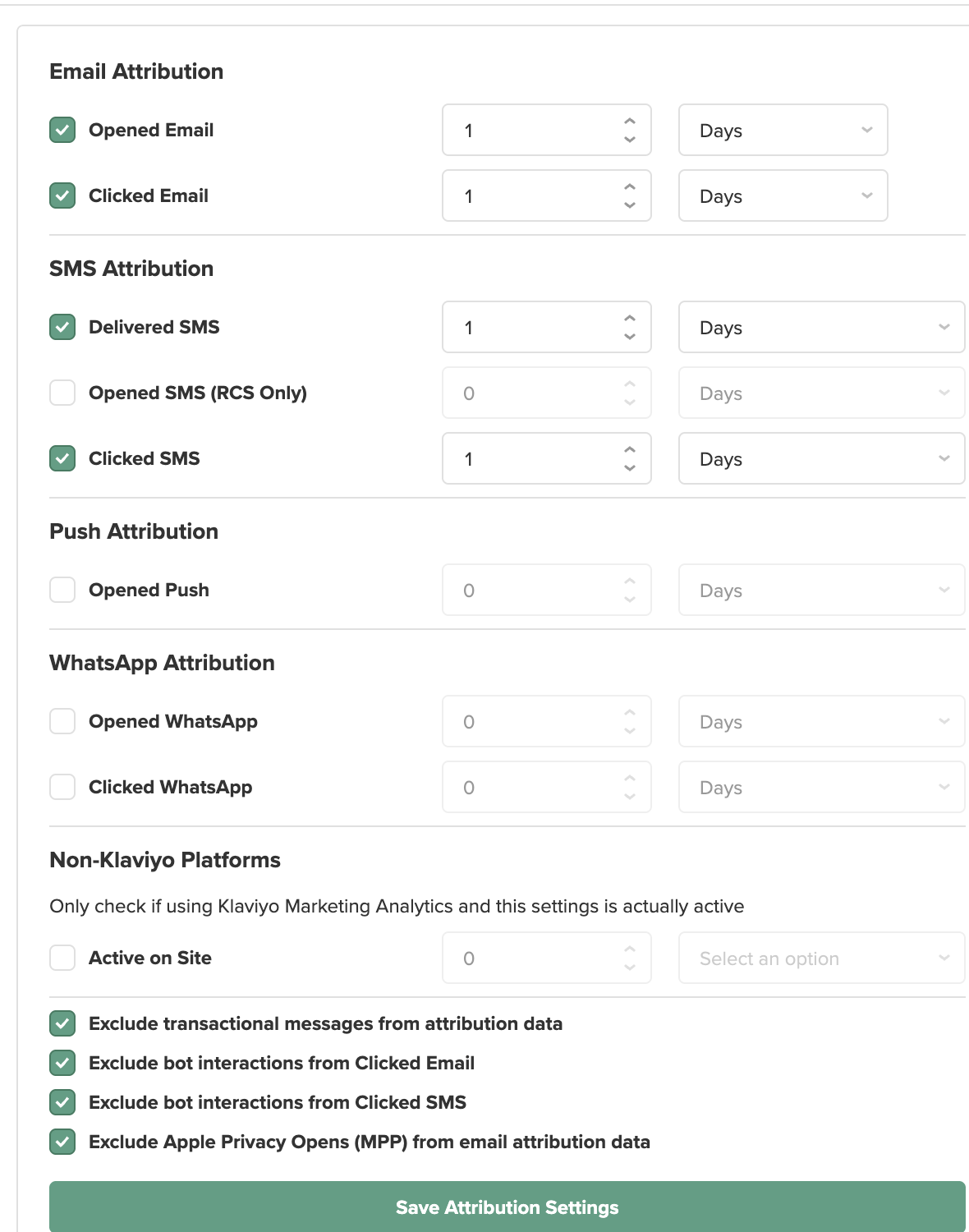
The evidence for this release is limited to the store platform result, the attributed performance summary, and this attribution configuration. Klaviyo and the external SMS platform are separate source systems. They are not shown as public totals here and are never added together, because two platforms can claim the same order.
Score your own retention system
Score each statement from 0 to 2. Use 0 when the system is absent, 1 when it exists but is inconsistent, and 2 when it is documented, operating, and reviewed. This is a diagnostic tool, not an industry benchmark. Your answers stay in your browser and are never submitted or stored.
Score all 12 statements to see your band. 0 of 12 scored. Your answers stay in this browser and are never sent anywhere.
The program has structural gaps. Start with ownership, measurement, capture, and the highest-value lifecycle work.
Important pieces exist, but inconsistent execution or weak coordination is limiting the result.
The system is mature enough for deeper testing, offer development, segmentation, and creative iteration.
Build your 90-day plan
Use the template below to turn the audit into an operating plan. Every phase needs an observable outcome, named evidence, and an exit condition before the next phase expands the system.
One baseline, one owner, and a prioritized build plan.
Audit capture, campaigns, flows, SMS, offers, consent, and reporting, then choose the first lifecycle and campaign priorities.
Baseline report, system map, campaign calendar, approved attribution dictionary, and an assigned owner.
Campaigns and lifecycle systems operate on a dependable cadence.
Launch priority flows, segmentation, list-capture tests, offer briefs, campaign production, and coordinated SMS.
Live systems, completed QA, weekly reporting, and a documented decision log.
Increase productive volume and improve the strongest systems.
Expand lifecycle coverage, increase campaign throughput, refine offers, improve creative, and scale winning segments.
Comparable-period report, source-linked result summary, and next-quarter priorities.
- The largest retention constraint is
- The metric and exact definition we will use is
- The first customer journey we will repair is
- The offer or message we will test is
- The source evidence we will save is
- The accountable role and review cadence are
How these numbers are measured
Full measurement rules and frozen definitions
Case-study math is only useful when every figure has a stable definition. These rules govern everything above.
- Keep total store revenue separate. Store revenue is the top-line business result. It is not presented as revenue caused entirely by retention marketing.
- Name the attribution model. Email, SMS, campaign, and flow figures identify the source platform and the approved one-day interaction windows.
- Disclose platform overlap. When two platforms can claim the same order, this page does not add those totals together without deduplication.
- Use comparable windows. The before and after periods use the same duration, time zone, order treatment, and inclusion rules.
- Tie every claim to evidence. Each public figure maps to a preserved source record.
- Define return on investment honestly. This release publishes no first-90-day return-on-investment claim.
The frozen definitions behind this release:
- Headline baseline: September 2024 store revenue of $131,796.75.
- Headline final window: Nov 20 to Dec 20, 2024 store revenue of $2,410,437.22.
- Channel comparison windows: Oct 20 to Nov 19 against Nov 20 to Dec 20, 2024.
- Email interactions: one day after an email open and one day after an email click.
- SMS interactions: one day after an SMS delivery and one day after an SMS click.
- Exclusions: Apple MPP opens, bot clicks, and transactional messages.
A few limits are worth stating directly. Store revenue reflects the whole business, so it is not the incremental contribution of any single channel. The attributed figures are Hiro attribution under the settings above, not incremental-revenue claims. Flow, campaign, email, and SMS rows are two ways of viewing one attributed total, so they are never summed into a larger number. Results from later periods are held out of this release until each has an attached source record.
See what we'd rebuild in your account
If your brand already has demand but email and SMS have not caught up, the answer is rarely one more campaign. ZHS Ecom builds and operates the coordinated system that captures more visitors, gives each customer a relevant next step, and gives your team one accountable owner. We handle strategy, campaigns, lifecycle automation, SMS, offers, segmentation, reporting, and ongoing iteration.