List Growth: The Offers That Actually Get Signups
Choose an offer that earns the signup, measure it with the right denominator, and grow a list of people you can actually serve.
- Build a list-growth offer that fits the buyer and margin
- Measure signup quality as well as conversion rate
Why does the offer decide everything on a popup?
The offer often has more leverage than visual polish because it determines whether the visitor sees a fair exchange for their contact information. Start with the offer and audience match, then test the form, copy, and timing around it.
Those are ZHS operating ranges, not an industry average or a promise. Compare the same denominator, completed signups divided by eligible visitors shown the form, and segment the result by device, traffic source, offer, and consent step.
Pick the offer before you touch design, copy, or timing. Match it to margin and buyer motivation: a planned first-order incentive for some products, early access for a premium brand, a quiz for a decision-heavy catalog, or useful education for a considered purchase. Test the offer first, one variable at a time, and judge both signup quality and downstream behavior.
ZHS has private client examples that outperform the operating range above. Those are first-party case observations with account-specific traffic, offer, and attribution conditions, not a baseline to promise or copy without a test.
Prefer to watch first? Here is the full walkthrough.
Should you use a discount or a non-discount offer?
It depends on margin, purchase friction, and brand positioning. A planned first-order incentive can reduce the perceived risk of trying an unfamiliar product; early access, a useful guide, a product finder, or a well-matched giveaway can be a better exchange when a discount would damage margin or positioning.
Most brands default to a percentage-off code because it is easy. It may work, but it is not the only option and it should be evaluated against the contribution margin and the quality of the customers it attracts.
Do not treat a non-discount offer as automatically higher quality, either. A generic giveaway can collect many people who only want the prize. The question is whether the person who signs up has a plausible reason to buy, learn, or return, not whether the form produced the largest raw count.
- "Sign up for our newsletter" with no reason to
- A vague promise of updates and deals
- An incentive that conflicts with the brand's pricing behavior
- An offer unrelated to the product decision
- A specific first-order incentive that clears the margin test
- Early access framed as a real customer benefit
- A product finder that produces a useful recommendation
- A guide, sample, or tool that shortens a real buying decision
The rule is simple: the value must be clear enough that the visitor understands why the exchange is worthwhile.
Should you use a discount or a non-discount offer
- 01Impulse or mid-price product?Test a planned first-order incentive
Make the benefit clear, then validate it against margin and new-customer behavior.
- 02Premium positioning?Test access, a useful resource, or a product finder
Protect the full-price story if a recurring coupon would undermine it.
- 03Tight margins?Test a benefit that preserves contribution
Shipping, service, bundles, or access can be more appropriate than a broad product discount.
- 04Catalog with variety?Test a recommendation quiz
Collect a useful preference only when it changes the recommendation or follow-up.
- 05Considering a giveaway?Validate buyer quality
Measure whether entrants become qualified subscribers and customers, not just whether the list grew.
A decision framework for an offer test, not a universal offer hierarchy.
What are the best lead magnets to grow an email list?
Choose the magnet that best fits the buyer's reason to act and the brand's economics. A first-order incentive, free-shipping threshold, giveaway, quiz, guide, sample, or early-access invitation can all be appropriate when the exchange is honest and the follow-up delivers what was promised.
| Magnet | Best fit | What to validate |
|---|---|---|
| First-order incentive | Products where trial friction is the main barrier | Margin, conversion, and whether buyers wait for a code later |
| Shipping benefit | Brands protecting product margin | Average order value and the real delivery promise |
| Giveaway or sweepstakes | A launch with a genuinely relevant prize | Consent, entrant quality, and downstream customer behavior |
| Quiz with a recommendation | Skincare, supplements, or varied catalogs | Whether each answer changes a useful recommendation |
| Guide or resource | Considered or education-heavy purchases | Whether the resource solves a real pre-purchase question |
| Product sample | Consumables and personal care | Fulfillment economics and likelihood of a second purchase |
| Early access | Brands with an engaged audience or limited releases | Whether the access is real and consistently honored |
You do not need every mechanic. Pick the one that fits the audience and margin, define the success metric before launch, then test a credible alternative against it. A quiz funnel is especially useful when the question itself can improve the recommendation.
The "mystery offer" is a legitimate test angle, not a universal winner. In some ZHS tests, curiosity-led framing has outperformed a plain percentage claim; in others, a transparent offer is more trustworthy. Make the reveal, eligibility, and terms clear enough that the customer is not surprised after opting in.
If discounting is rare, do not assume a coupon is required to grow the list. Test access, education, a recommendation, or another benefit that reinforces the brand's full-price proposition.
How does a two-step popup capture both email and SMS?
Use a two-step capture path when it creates a real, voluntary reason to collect each channel: email first for the primary offer, then a separate optional SMS opt-in with clear marketing disclosure. Do not make an already-promised email benefit conditional on marketing-text consent.
The default sequence is least intrusive to most intrusive: collect only the data needed to fulfill the immediate exchange, then ask for more only when it creates a distinct customer benefit. The exact field order, incentive, and disclosure need to match the program and be tested without compromising consent.
How does a two-step popup capture both email and SMS
- 01Step oneState the offer and capture the email
Use the minimum fields needed to fulfill the promise. The next step should not retroactively change that promise.
- 02Step twoOffer an optional SMS benefit
Explain the marketing program, use an affirmative opt-in path, and make the added value distinct from the email offer.
A consent-aware capture pattern; have counsel approve the final disclosure and program behavior.
If you use a texted code, present it as an optional redemption or confirmation path with clear disclosure, not as a way to force marketing consent. Keep the promise on the popup, confirmation page, and welcome flow consistent with what the person actually agreed to receive.
How do you collect zero-party data at signup?
Ask one question only when its answer will change the visitor's experience. A product interest, goal, size, routine, or use case can route the welcome flow and product recommendation; a question that has no downstream job is extra friction.
Use a clear answer set and store the result as a deliberate profile property or event. Then verify that the welcome sequence, product block, or audience rule actually uses it. The welcome flow should speak to a stated interest instead of pretending every subscriber wants the same thing.
Before adding a question, complete this sentence: "If the visitor chooses this answer, we will change ____." If the answer is nothing, remove the field.
When should a popup fire, and what copy converts?
Show the popup after a visitor has had a fair chance to understand the page or signaled interest, then test trigger logic separately on desktop and mobile. Lead the copy with the exchange, keep the next action obvious, and make dismissal straightforward.
Timing is not a universal preset. A visitor arriving from a branded campaign, a returning shopper, and a first-time product-page visitor have different context. Use delay, scroll, exit behavior, page depth, or intent signals as hypotheses and compare the same audience cohorts before changing a site-wide rule.
The copy should say what the visitor gets, what information they provide, and what happens next. A low-friction question can help someone choose to continue, but do not disguise the opt-in or make the decline path inaccessible.
Make the positive action clear without hiding, shaming, or disabling the decline action. A signup gained through confusion is not the kind of permission a retention program should build on.
Full-screen forms are worth testing where they fit the site experience, particularly on mobile. Judge them against completion quality, purchase impact, accessibility, and the ability to dismiss, not raw signup volume alone.
What should you split test first on a popup?
Test the offer first, then the trigger, then the copy, then the creative treatment. Change one meaningful variable at a time, predefine the success metric and minimum observation window, and keep the winning version only after the result is durable enough to trust.
The benchmark is an operating range, not an expected staircase. Some experiments produce no lift; some reveal that a higher submission rate produces worse customer quality. Evaluate the full path, including consent quality, welcome-flow engagement, conversion, margin, and unsubscribe behavior.
Illustrative progression only, not a benchmark, forecast, or required sequence of results.
How long a test needs depends on exposure, conversion rate, traffic mix, and the materiality of the decision. Use the A/B testing guide to set the design before you call a winner.
What is a good popup signup rate, and how do you measure it?
Track completed signups divided by eligible visitors shown the form, not total site sessions, and compare like traffic sources and devices. Use the canonical ZHS ranges below as a diagnostic starting point, then set a specific target from your own baseline, offer, and consent design.
| Measure | What a useful view looks like |
|---|---|
| Email completion | Completed, valid email signups divided by eligible people who saw that step |
| SMS step completion | Voluntary, documented marketing opt-ins divided by people eligible for that separate step |
| Subscriber quality | Welcome engagement, purchaser conversion, margin, complaints, and unsubscribe trend by offer |
| Popup impact | List growth alongside on-site conversion, accessibility, and customer-experience signals |
If the submit rate is weak, start by checking the offer-audience match and the denominator before changing button colors.
What are the most common popup and lead magnet mistakes?
The most costly mistakes are generic value propositions, incentives that do not clear the margin test, unclear SMS consent, unused signup data, and judging the form only on raw submissions. Fix the operating design before chasing a visual tweak.
- A generic offer. Give a visitor a specific reason to exchange their information.
- Discounting without an economics decision. A coupon can be appropriate, but it should be intentional rather than the default.
- Treating SMS as a free add-on. Use a separate, voluntary consent path and deliver a distinct benefit.
- Ignoring margin and fulfillment. The offer is only successful if the resulting customer economics work.
- Asking for data you never use. Add a zero-party question only when it changes a real next step.
- Using the wrong denominator. Measure eligible form viewers, not all sessions.
- Calling a winner too early. Test one variable at a time and verify the outcome across the relevant customer-quality signals.
Get Expert Help
Picking the right offer for your margin, then wiring up a consent-aware capture path and the flows behind it, is where most brands stall. Our team builds and tests the whole system so the list grows with people the brand can genuinely serve.
More patterns to study
Curated creative references for this lesson. Study the mechanism, then adapt it to your own audience, offer, and evidence.

🍄Welcome, new friend! 🍄
Pattern: Happy Finnish founder unlocks Nordic wellness secret.
Use it here: The first email should deliver on the reason someone subscribed, then introduce the brand in a way that preserves that promise.
Open reference in new tab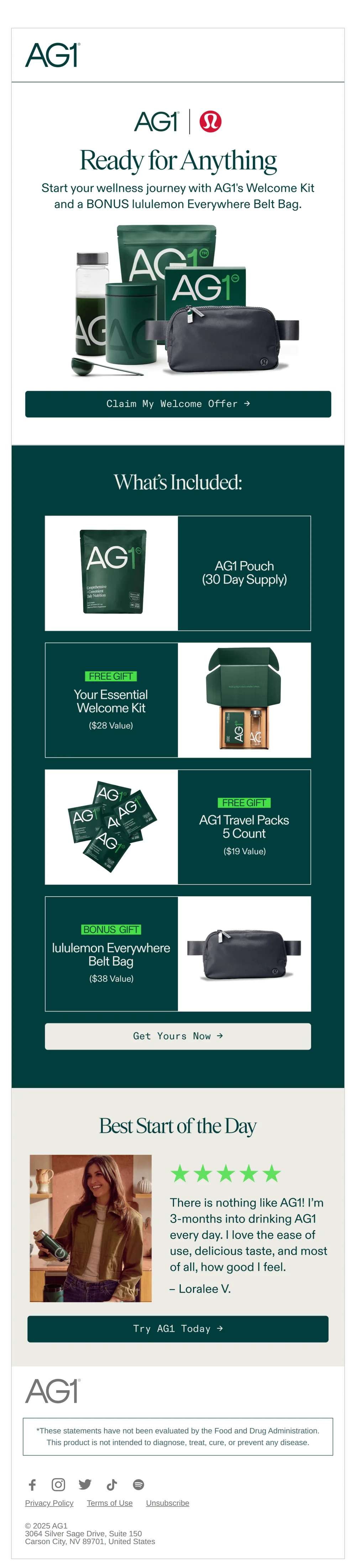
Get a BONUS lululemon Bag with subscription
Pattern: AG1 x lululemon collab bundle as welcome offer.
Use it here: A welcome incentive can feel like a fuller value proposition when the benefits are clear; keep offer terms and subscription claims truthful.
Open reference in new tabCreative and design curation only. These are role references, not reported revenue, conversion, or a promise that the exact tactic will transfer unchanged.
Need help implementing this?
We build and manage complete email & SMS programs for DTC brands. Get a custom plan for your brand.
Get Your Free Audit + Gameplan