Subscription Retention Marketing: The Lifecycle System for Recharge and Klaviyo
Build a subscription lifecycle that reduces preventable churn: activation, upcoming-order management, failed-payment recovery, skip and swap paths, cancellation feedback, and winback.
- Choose the right retention metric and denominator
- Turn performance signals into an operating decision
What does a complete subscription retention program include?
A complete subscription program manages the moments that create or prevent churn: activation, onboarding, the first successful recurring order, upcoming-order control, payment recovery, skip or swap decisions, cancellation feedback, pause, and winback. The job is not to send more reminders. It is to make the subscription predictable, easy to control, and valuable enough to keep.
Build the lifecycle from provider events and customer state, not from a generic newsletter list. Recharge can send events and profile properties into Klaviyo; those signals should decide which flow a subscriber enters and when they exit.
The subscription retention lifecycle
- 01ActivationSet expectations
Confirm cadence, product, price, next charge, management link, and what happens next.
- 02Early useCreate the first value moment
Teach usage, routine, storage, and outcome before the first renewal decision.
- 03Pre-chargeGive control before billing
Show the upcoming order and make skip, swap, add-on, and date changes easy.
- 04ExceptionRecover payment or prevent cancellation
Route failed payments, pause intent, product fatigue, and support issues to the correct recovery path.
- 05After exitLearn and win back selectively
Capture cancellation reason, stop active-subscriber messaging, and offer the relevant return path later.
Every stage needs a clear event, owner, customer action, and exit condition.
Which subscription events should Klaviyo receive?
At minimum, verify activation or subscription start, upcoming order or charge, successful recurring order, cancelled subscription, paused subscription when supported, and the events involved in payment recovery. The exact event names depend on the provider and integration version. Do not build from a screenshot or copied event name until the metric has fired in the actual account.
Recharge notes that a metric may not appear in Klaviyo until the corresponding event occurs. Use controlled test customers to trigger and inspect events, then open the Klaviyo profile activity feed and preview the event payload. Record the event name, timestamp, customer identity, subscription ID, product, cadence, next charge, status, and available management URL.
How should activation and onboarding work?
Activation should remove uncertainty immediately. Confirm what the customer subscribed to, frequency, price, next charge date, shipping expectations, and where to manage the subscription. Then teach the product routine before the first renewal decision. A supplement may need consistency guidance; a consumable may need storage and serving ideas; a beauty product may need a usage sequence.
Do not confuse transactional confirmation with marketing permission. The required service message and optional lifecycle marketing can have different legal bases and channel rules. Maintain the correct consent checks, particularly for SMS.
What should an upcoming-order flow do?
An upcoming-order flow should prevent surprise and give the customer useful choices: keep, skip, reschedule, swap, or add a one-time item. Recharge's upcoming-order event is sent before the charge window and can carry order data into Klaviyo. Its Quick Actions can support direct subscription-management actions, but every link must be tested against a real test subscription.
The operational goal is not simply to reduce cancellations. It is to move avoidable cancellations into a better choice. Someone with too much product may need a skip or longer cadence. Someone bored with the product may need a swap. Someone traveling may need a reschedule. Someone confused may need support.
Route the pre-charge decision
Preserve the relationship without forcing inventory.
Use active product and preference data when available.
Keep the order but move the charge or delivery date.
Use a save offer only when margin and predicted value support it.
Do not automate around an unresolved service issue.
How should failed-payment recovery work?
Payment recovery is primarily an operational system. The payment processor and subscription platform decide retries; email and SMS make the problem visible and give the customer a secure way to update payment. State what failed, what action is required, when the next retry occurs if known, and where to fix it. Stop recovery messages as soon as payment succeeds or the subscription closes.
Never request payment credentials inside an email or text. Link to the authenticated provider experience. Coordinate marketing exclusions so a customer in a billing problem does not simultaneously receive tone-deaf promotional pressure.
How should cancellation, pause, and winback differ?
Cancellation, pause, and payment failure are different states. A cancelled subscriber has chosen to end. A paused subscriber still has an active relationship with a future return point. A failed-payment subscriber may want to stay but cannot complete the charge. Each needs a different message, timing, and exit rule.
Subscription exception paths
| Criteria | Primary job | Immediate message | Exit condition |
|---|---|---|---|
| Payment failure | Restore billing | Update payment securely | Successful charge or closed subscription |
| Pause | Maintain confidence | Confirm pause and restart date | Subscription resumes or cancels |
| Cancellation | Confirm and learn | Respect the exit; capture reason | Cancellation confirmed |
| Winback | Re-establish fit | Address the recorded cancellation reason | Reactivation or sunset |
Winback should respond to the reason for leaving. Do not send the same coupon to someone who cancelled for product fit, excess inventory, price, and a service failure. Some customers should not receive an automated winback until support resolves the underlying issue.
How do you segment subscribers without relying on one active flag?
Use event history plus current properties. An active subscriber property is helpful but may lag, change type, or describe the customer rather than an individual subscription. Combine it with active product, subscription count, next charge date, cancellation count, charge count, and recent provider events. Recharge documents rc_ properties that can support this work, while also noting that some payload fields are intended for flow personalization rather than segmentation.
Build separate audiences for new subscribers, active subscribers by tenure, upcoming orders, prepaid plans, paused subscribers, payment-recovery state, recently cancelled, reactivated, VIP subscribers, and active subscribers with open support issues.
How do you prevent duplicate subscription notifications?
Name one sender for every notification. If Recharge sends the upcoming-order email, the equivalent Klaviyo flow must not also send. If Klaviyo takes ownership, follow the provider's cutover instructions and test the transition window. Keep a notification inventory with event, purpose, transactional or marketing classification, sender, channel, timing, and owner.
Recharge warns that re-enabling certain upcoming-order notifications can send to every customer inside the configured window, which can produce duplicate messages during a transition. Treat notification ownership changes like a migration, not a toggle.
How should subscription flow QA work?
Test with real provider events and test subscriptions. Previewing template copy is insufficient because the failure usually lives in identity, event payload, management URL, status, or exit logic.
Subscription flow QA
- The provider event fires in the real account
- Klaviyo receives the event on the expected profile
- Event properties render for multiple products and cadences
- Transactional and marketing consent rules are correct
- Management, skip, swap, reschedule, and payment links work
- Successful charge exits payment recovery
- Cancellation exits active-subscriber messaging
- Pause messaging reflects the restart state
- Support cases suppress inappropriate promotions
- Recharge and Klaviyo do not send duplicate notifications
- Time zones, quiet hours, and send windows are tested
- Reporting separates retained, recovered, skipped, swapped, and reactivated outcomes
What should subscription retention reporting measure?
Measure the state change, not merely the message engagement. Track activation-to-first-renewal, successful recurring charges, payment recovery, voluntary cancellation, pause, skip, swap, reschedule, add-on acceptance, reactivation, subscriber tenure, and contribution margin by cohort. Email clicks help diagnose the path; they are not the retention outcome.
For experiments, define the decision unit before launch. A save offer can reduce immediate churn and still destroy margin or train customers to threaten cancellation. Compare retained contribution and later tenure, not only the number of customers who clicked "stay."
What is the ZHS operating principle for subscription retention?
Give customers control before they feel trapped. Use lifecycle data to solve the real reason they may leave, keep service and billing states out of generic promotional messaging, and make every automated path stop when its job is complete.
Subscription retention is not one cancellation flow. It is the operating system around every renewal decision.
More patterns to study
Curated creative references for this lesson. Study the mechanism, then adapt it to your own audience, offer, and evidence.

Pop Quiz: Is Your Protein Bar Actually Good? 🧪
Pattern: quiz-style test helps you choose smarter protein bar.
Use it here: Use helpful education between subscription moments to make the product easier to choose or use, not as a substitute for event-based lifecycle controls.
Open reference in new tab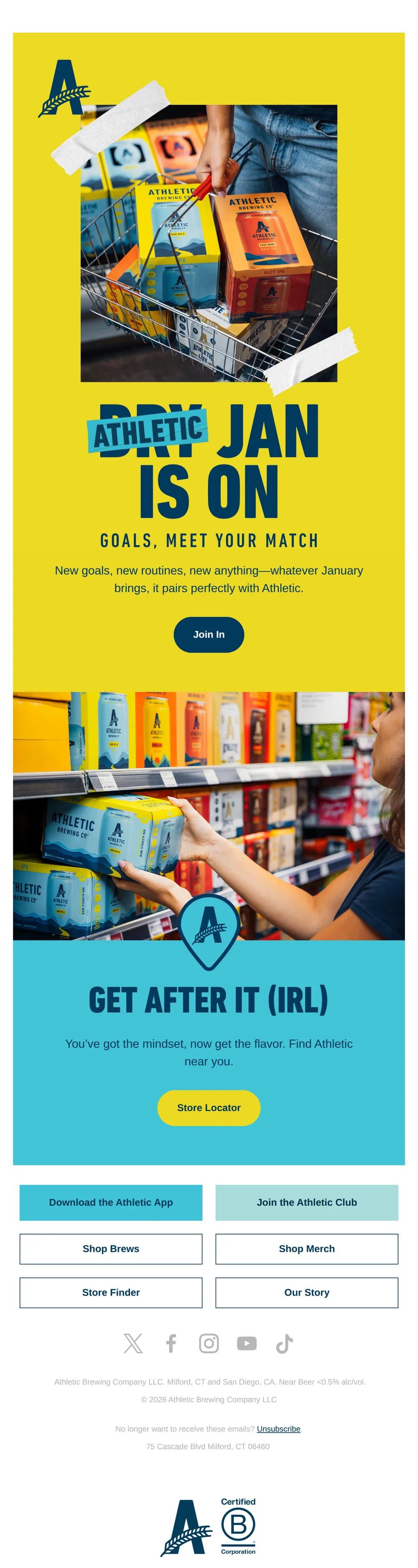
Reset. Refill. Repeat.
Pattern: Dry January is your excuse to drink Athletic.
Use it here: A routine cue can reinforce ongoing use when it matches the product cadence; upcoming-order, skip, and payment states still need their own logic.
Open reference in new tabCreative and design curation only. These are role references, not reported revenue, conversion, or a promise that the exact tactic will transfer unchanged.
Need help implementing this?
We build and manage complete email & SMS programs for DTC brands. Get a custom plan for your brand.
Get Your Free Audit + Gameplan