The Winback Flow: Re-Engage Customers Before They Churn
Build a product-aware winback flow with a defensible lapse definition, consent-aware eligibility, purchase exits, and a clear measurement plan.
- Build the trigger, timing, branches, and exits for this flow
- Measure and improve the flow against a stable cohort
Why is a winback flow cheaper than acquisition?
A winback flow targets a past buyer whose reorder window has passed. That history can make the audience more informed than a cold prospect, but there is no universal acquisition-cost multiple or conversion rate. Size the opportunity from lapsed eligible buyers, observed reorder behavior, contribution margin, offer cost, and incremental reactivation.
Set the lapse window from the observed reorder distribution and product context. Run a short sequence that leads with product or relationship value before an economically defensible offer. Enter only eligible subscribed buyers and exit immediately on purchase. If the profile is already 90+ days dormant and shows no reliable engagement through reactivation, hand it to the canonical sunset path.
A past buyer has product and purchase history that can inform a more relevant message. That does not prove a fixed cost advantage or conversion rate; use a comparable cohort or holdout when the economic decision is material.
When is a customer considered lapsed?
A customer is lapsed when the brand's documented reorder expectation has passed without another qualifying purchase. There is no universal lapse window: consumables, replenishable products, seasonal products, and durable purchases need different rules.
Use the observed distribution of time between orders, product and SKU context, subscription state, and seasonality to choose the window. For a product that naturally runs out, a dedicated replenishment reminder flow should usually address the customer before a broad winback flow.
Define lapse from the product, not a copied calendar rule
Eligible prior buyer + passed product-specific reorder expectation + no qualifying reorder = winback candidate- Use a stable purchase and product definition.
- Exclude active subscriptions or other states that make a reorder reminder irrelevant.
- Review category-level behavior before applying a store-wide rule.
ZHS operating definition. Confirm the actual window in the account and document it beside the flow trigger.
Most email platforms report average time between orders. Use your actual data. A coffee brand and a mattress brand should never share the same lapse window.
Who should enter the winback flow?
Enter someone only when two things are true: no purchase within your lapse window, and still subscribed. Do not enter contacts who already unsubscribed or hard bounced. You want real buyers who drifted away, not dead addresses that hurt your sender reputation.
Enter someone into the flow when two things are true: no purchase in X days (your lapse window), and still subscribed.
Do not enter people who already unsubscribed or hard bounced.
You want to reach real buyers who drifted, not spam dead addresses.
What emails go in a winback sequence?
The visual map shows the current ZHS starting configuration: lead with a relevant reason to return, add product proof or a clear update, introduce an economically defensible offer only when it is warranted, and end with a truthful preference or reactivation decision. It is a baseline to adapt, not a universal calendar.
Lead with connection and product relevance before increasing incentive. Test the offer order against a comparable cohort and preserve a purchase exit on every remaining message.
View full build
Read the text version
Trigger: When a customer passes the product-specific lapse window
Entry filters: Passed the product-specific lapse window; Can receive marketing
Exit conditions: Placed Order since entering; Cannot receive marketing
Re-entry: Allow re-entry after a later purchase and new lapse period
- email: Email 1We miss you, here is what is new
- delay: Wait 4 days
- email: Email 2Bestsellers, new arrival, or relevant restock
- delay: Wait 4 days
- email: Email 3A meaningful reason to return
- delay: Wait 6 days
- email: Email 4Is this goodbye?
What emails go in a winback sequence
- 01Day 0We Miss You, Here Is What Is New
Warm, personal tone. Show new arrivals or product updates since they last bought. NO discount yet.
- 02Day 4A Reason to Return
Best sellers, new arrivals, or a restock they care about. Sell the product, not a coupon.
- 03Day 8A Stronger Incentive
Now bring the offer. A meaningful discount, free shipping, or a gift with purchase for the ones still on the fence.
- 04Day 14Is This Goodbye
A short, honest last email. Ask if they still want to hear from you and let them confirm interest or opt down.
Structured from the canonical article steps for responsive reading and presenter mode.
The final email does double duty. It gives one last nudge, and it flags who is truly gone so you can act on it.
When should you sunset a contact?
Sunset a profile after it reaches the 90+ day dormant tier, completes the approved reactivation sequence, and still shows no reliable click, purchase, site activity, or trustworthy engagement signal. Send the clear last-chance messages, then suppress persistent inactivity. Do not let Apple-inflated opens rescue an otherwise inactive profile.
Winback and list hygiene are the same job.
If a dormant profile completes winback without reliable engagement, move it into the canonical sunset flow.
Send one or two "last chance to stay subscribed" emails, then suppress the ones who still do not engage.
When should you sunset a contact
- 0190+ days dormantFlag for reactivation and sunset
The profile is outside routine campaigns and has no reliable recent engagement signal.
- 02Sunset email 1Ask for an explicit signal
One short, honest ask with a clear preference or confirmation action.
- 03Sunset email 2Confirm the consequence
Explain that routine marketing will stop without a reliable response.
- 04No reliable responseSuppress, do not delete
Stop marketing sends while preserving profile history and compliance state.
Structured from the canonical article steps for responsive reading and presenter mode.
Suppressing dead contacts protects your sender reputation and your deliverability. Mailbox providers watch engagement. Keep emailing people who never open, and your good subscribers start landing in spam too. Building engagement tiers into your segmentation keeps that damage contained.
What are good winback flow benchmarks?
There is no universal open, conversion, or reactivation band for winback. Evaluate a winback sequence against its own eligible lapsed-buyer cohort, with the same product definition, offer treatment, attribution window, and exclusion rules. The useful question is whether the flow improves incremental reactivation without producing disproportionate opt-outs, complaints, or margin erosion.
| Measure | Keep the definition stable | Use it to decide |
|---|---|---|
| Eligible lapsed buyers | Lapse rule, purchase history, subscription state, and channel eligibility | Whether the flow is entering the right people |
| Reactivation | Qualifying next purchase within the recorded window | Whether the sequence is helping a buyer return |
| Contribution after offer cost | Margin, discount, shipping, and incentive treatment | Whether the offer is economically defensible |
| Opt-outs and complaints | Delivered-message denominator and acquisition source | Whether the winback pressure is harming permission or trust |
What are the most common winback mistakes?
The five that cost the most: leading with your biggest discount, never sunsetting, emailing unengaged contacts forever, using one lapse window for every product, and having no exit on purchase. Each one either burns margin or drags down deliverability for your whole list. Fix the offer order and the exit rules first.
-
Leading with the biggest discount. You give away margin to people who would have returned anyway. Escalate the offer, do not open with it.
-
Never sunsetting. Unengaged contacts drag down deliverability for your whole list. Suppress them on a schedule.
-
Emailing unengaged contacts forever. A "loyal" list of non-openers is a liability, not an asset. Cut it loose.
-
One lapse window for every product. Set the window from your real reorder cycle, not a round number you copied from a blog. If you sell across categories, split entry by product segment so each cohort gets the right timing.
-
No exit on purchase. If they buy mid-flow, they exit immediately and never see the discount email.
Technical Checklist
Triggers:
- Lapse window set from your average time between orders
- Entry requires an active subscription
Segmentation:
- Split by product type if reorder cycles differ
- Exclude anyone already unsubscribed or bounced
Exit Conditions:
- Purchase exits the flow immediately
- Re-engagement (open or click) can shorten the sequence
List Hygiene:
- Dormant profiles complete reactivation before suppression based on reliable inactivity
- Suppression runs automatically, not by hand
Get Expert Help
Winback and sunset flows are part of every retention package we build.
Our team sets your lapse windows from your real order data, writes the sequence, and keeps your list clean so your deliverability holds.
More patterns to study
Curated creative references for this lesson. Study the mechanism, then adapt it to your own audience, offer, and evidence.
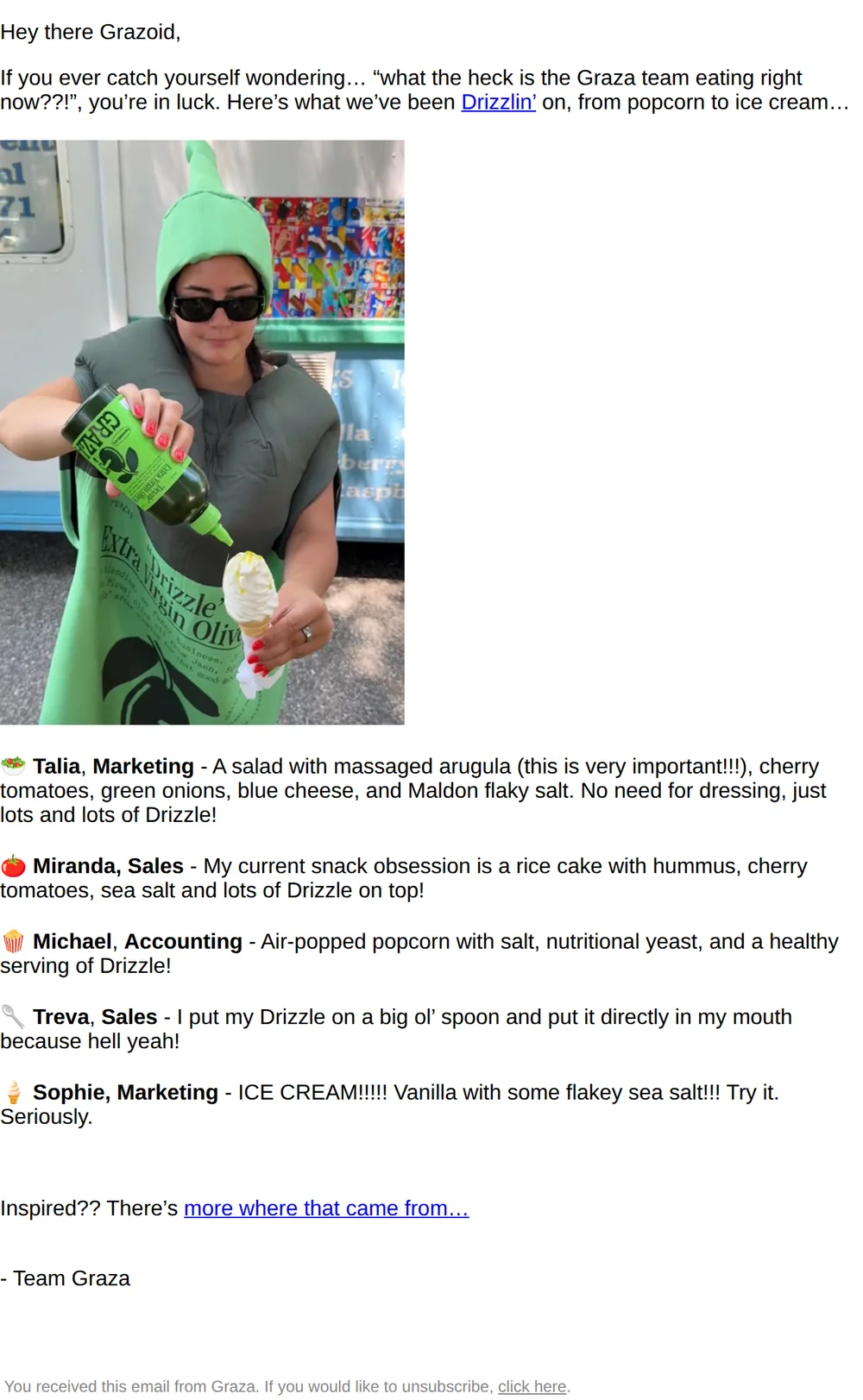
What we’re Drizzlin’ on 🫒
Pattern: Team shares wild ways they use Drizzle.
Use it here: A human-sounding update can be a strong re-entry point when it offers a real new reason to care rather than repeating the old purchase prompt.
Open reference in new tab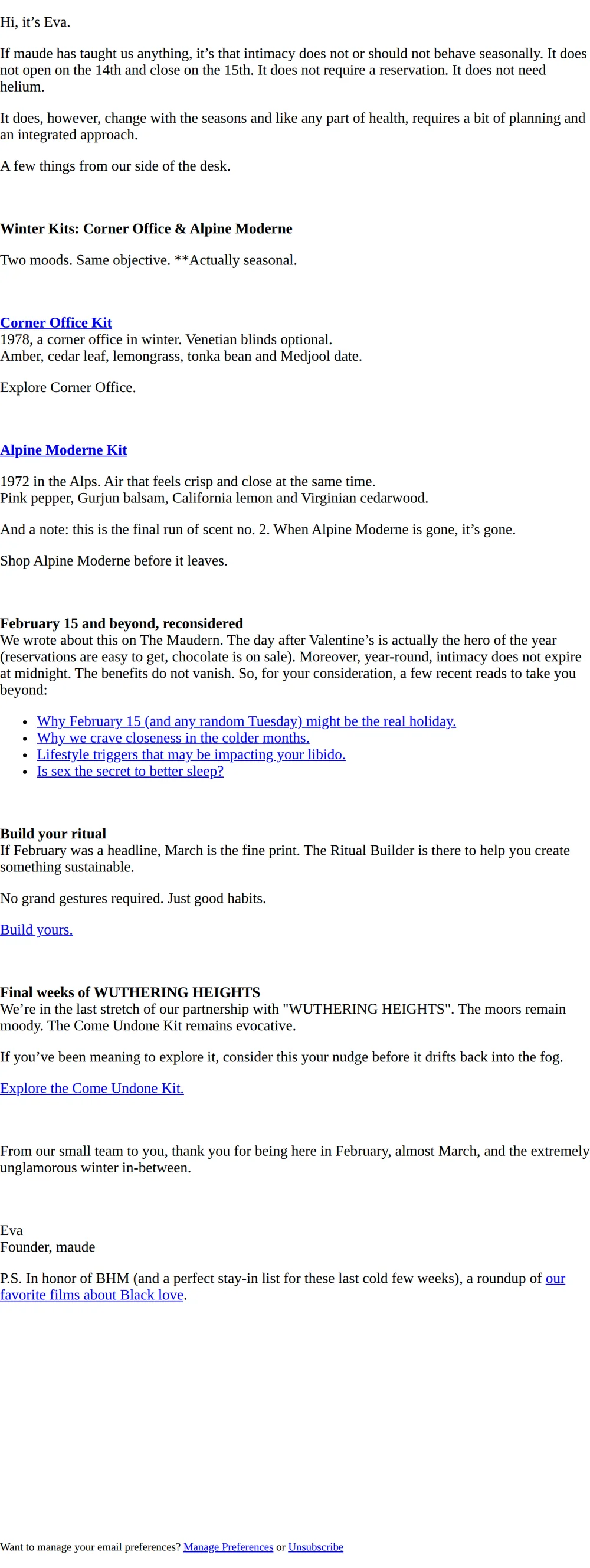
Intimacy isn't seasonal
Pattern: intimacy doesn't expire on February 15th.
Use it here: A preference-led message can close a winback sequence honestly; route the response into the correct consent and engagement state.
Open reference in new tabCreative and design curation only. These are role references, not reported revenue, conversion, or a promise that the exact tactic will transfer unchanged.
Need help implementing this?
We build and manage complete email & SMS programs for DTC brands. Get a custom plan for your brand.
Get Your Free Audit + Gameplan