The Sunset Flow: Protect Your Deliverability on Purpose
Build a documented reactivation and suppression policy that protects permission, preserves profile history, and avoids treating privacy-inflated opens as proof of interest.
- Build the trigger, timing, branches, and exits for this flow
- Measure and improve the flow against a stable cohort
What is a sunset flow, and why does it protect deliverability?
A sunset flow moves profiles in the documented dormant tier out of routine campaigns, asks for a reliable signal of continued interest, and suppresses persistent inactivity without deleting profile history. The ZHS starting tier uses ninety-plus days of reliable inactivity, but the policy should be reviewed against actual send frequency and product behavior. Use clicks, purchases, site activity, and trustworthy open signals; Apple Mail Privacy Protection makes opens alone unsafe as the deciding criterion.
Repeatedly mailing profiles with no reliable interest can create cost and sender-reputation risk. Inbox-provider logic is not a published universal engagement formula, so do not promise that suppression automatically fixes inbox placement. This is the big list deliverability trap: manage the audience deliberately and measure the result.
The sunset flow creates a transparent decision path: invite a clear response, then stop routine marketing for profiles that remain reliably inactive.
List hygiene protects the audience that makes retention compounding possible. ZHS reports more than $50 million in cumulative platform-attributed client retention revenue, but that aggregate should not be used to claim suppression caused a specific amount. The narrower operating point is that repeatedly sending to reliably inactive profiles raises cost and reputation risk without creating equivalent customer value.
Here is what the sunset flow does and how to measure whether it improves list health.
Define the dormant tier at 90+ days without reliable engagement and exclude profiles whose recent purchase or site behavior proves active intent. Send a short last-chance sequence, then suppress profiles that still produce no reliable response. Suppress rather than delete so history and consent state remain intact. Review the policy and tier movement on a fixed cadence.
How do you define an unengaged subscriber?
Under the canonical ZHS tier system, dormant begins after ninety-plus days without a reliable engagement signal. Exclude recent buyers and meaningful site activity. A trustworthy click, purchase, preference confirmation, or other intentional action can return a profile to the appropriate tier; an Apple-inflated open alone should not.
Use the engagement tiers as a four-tier operating model: highly engaged, warm, cool, and dormant. The key is not adding more arbitrary windows. It is making the segment logic mutually exclusive, auditable, and based on signals that reflect deliberate interest.
- Document the dormant window. The ZHS starting point is the canonical ninety-plus-day tier; adapt only with a stated reason tied to send frequency and product behavior.
- Define reliable signals. Favor clicks, purchases, site activity, and preference confirmation. Treat privacy-affected opens carefully.
- Exclude current customers and relevant activity. A recent buyer or other meaningful action should not be treated as silent merely because an open is unavailable.
What emails go in a sunset flow?
The visual map is the current ZHS starting configuration: invite a response, make a single clear reactivation proposition, explain the consequence truthfully, then suppress a profile that remains reliably inactive. It is a baseline, not a universal calendar or promised reactivation rate.
Do not suppress people without a transparent preference or reactivation opportunity unless a safety, compliance, or consent condition requires an immediate stop.
View full build
Read the text version
Trigger: When someone enters the approved unengaged segment
Entry filters: Entered the approved MPP-safe unengaged segment
Exit conditions: Reliable engagement returns; Profile is suppressed after remaining inactive
Re-entry: Do not re-enter after suppression unless they opt in again
- email: Email 1We miss you. Do you still want these?
- delay: Wait 3 days
- email: Email 2One strongest reactivation offer
- delay: Wait 3 days
- email: Email 3We will stop emailing you tomorrow
- delay: Wait 1 day
- Conditional split: Clicked any message in this flow
- Yes · Keep active
- action: Return to an engaged segment
- No · Stayed silent
- action: Suppress profile
- Yes · Keep active
What emails go in a sunset flow
- 01Day 0We miss you
A plain, human email. Subject line along the lines of "We miss you, are you there?" Remind them why they subscribed and tell them about the new products they are missing by not being on your engaged list. Keep it plain text and conversational so it feels personal, not like a blast.
- 02Day 3One strong offer
Your absolute best offer, once. Something you would not normally run: a massive discount, free shipping, an exclusive deal. Great subject line, great preview text, and one clear reason to click. This is your highest-effort attempt to earn a single click.
- 03Day 6Removing you tomorrow
The honest goodbye. "We are about to stop emailing you. Click here to stay." This send wins back more people than the friendly ones because the stakes are real.
- 04Day 7Suppress the silent
Anyone who opened or clicked goes back into your engaged tiers. Everyone who stayed silent gets suppressed. No guilt, no exceptions.
Structured from the canonical article steps for responsive reading and presenter mode.
Reliable engagement should return a profile to the appropriate tier. Persistent inactivity should move the profile to suppression under the documented policy.
Make opting out the easy path. Do not bury the unsubscribe link at the bottom. Put a message near the top in big bold red text: if you want off this list, click here, that is totally fine. It feels counterintuitive, but it is mutually beneficial. A person who clicks that link instead of hitting the spam button just handed you clean data and protected your reputation at the same time. You would much rather they opt out than mark you as spam.
Batch your sends. On a big list, do not fire the whole re-engagement series at everyone at once. Break it into smaller batches spread over a longer window. Dumping thousands of low-engagement sends in one day is exactly how you tank your deliverability while trying to save it.
Watch the right metrics as it runs. Compare delivery, reliable clicks, reactivation, bounces, unsubscribes, complaints, and downstream revenue against the dormant cohort and prior policy. Do not invent an open-rate floor for a privacy-affected audience.
Suppressing generally preserves the profile history and consent state while stopping routine marketing sends. Confirm the current platform's billing, retention, and suppression behavior in its documentation before using it as an operational or cost claim. Do not delete data simply to make a list look cleaner without confirming the reporting and compliance consequences.
In Klaviyo the cleanup is fast. Build a segment of the people who stayed silent, then bulk suppress that whole segment in one action. There is no reason to do this by hand.
Does removing subscribers hurt or help your email reach?
Suppressing reliably inactive profiles reduces the audience you can mail, but it can be the right tradeoff when continued sending adds cost or reputation risk without evidence of customer value. It does not guarantee better inbox placement or revenue; measure list health and commercial outcomes before and after the policy rather than treating a smaller list as success by itself.
The goal is not to make a metric look better. It is to keep routine marketing focused on people who have a defensible reason to receive it.
How does the sunset flow fit with tiers and winback?
It is the last stop in a three-part system. Engagement tiers guide normal campaign eligibility using reliable recent behavior. A winback flow addresses a past buyer whose product-specific reorder expectation has passed. The sunset flow handles persistent inactivity after a transparent reactivation attempt, then suppresses profiles that remain silent. The exact eligibility rules belong to the documented tier and flow definitions, not a copied calendar.
The sunset flow is not a standalone trick. It is the last stop in a system.
| Stage | Who it targets | What happens |
|---|---|---|
| Engagement tiers | Profiles with reliable recent behavior | Receive the appropriate normal-campaign cadence |
| Winback flow | Eligible prior buyers past the product-specific lapse definition | A relevant reactivation journey with a purchase exit |
| Sunset flow | Still silent after winback | Last-chance sequence, then suppress |
Winback is the gentle nudge. The sunset flow is the final decision after that nudge fails.
The winback flow itself runs from a documented lapse definition applied to qualifying prior buyers. It should have a purchase exit, an economically defensible proposition, and a measurement plan rather than a generic promise of recovery.
The one thing you cannot copy from another brand is the winback window. It depends on the product, reorder behavior, subscription state, and seasonality. Set the window from your own buying rhythm, then document it beside the trigger.
Run these in order. Tiers keep your engaged people happy, winback catches the ones slipping away, and the sunset flow clears out whoever is truly gone so your reputation stays clean.
Then keep it running. Review tier movement, reactivation outcomes, complaints, and suppression behavior on a recurring operating cadence, the same habit covered in our flow audit checklist. The point is that this is a maintained system, not a one-time cleanup.
What are the most common sunset flow mistakes?
The biggest mistake is applying a suppression policy without a documented eligibility rule, a transparent reactivation step, or a way to preserve history. Other common errors include relying on opens alone, including recent buyers, and never reviewing the outcome. Here are the six to avoid.
- Deleting instead of suppressing. You lose the data and can never run a future winback. Always suppress.
- No transparent reactivation step. Unless an immediate stop is required, give a clear preference or reactivation path before routine marketing ends.
- Sunsetting on opens alone. Use reliable signals such as clicks, purchases, site activity, and explicit preference confirmation; privacy-affected opens need caution.
- Including recent buyers. A customer who purchased but never opens is still paying you. Exclude them from the flow.
- Running it once and forgetting it. Make it a live, always-on flow so the list never rots again.
- Treating it as automatic revenue protection. Suppression can be a sound permission and deliverability policy, but it still needs outcome measurement.
Get Expert Help
A clean sunset flow is a documented permission and audience-management policy. Our team can build the engagement windows, reactivation sequence, and suppression rules, then measure the resulting list-health signals alongside commercial outcomes.
More patterns to study
Curated creative references for this lesson. Study the mechanism, then adapt it to your own audience, offer, and evidence.
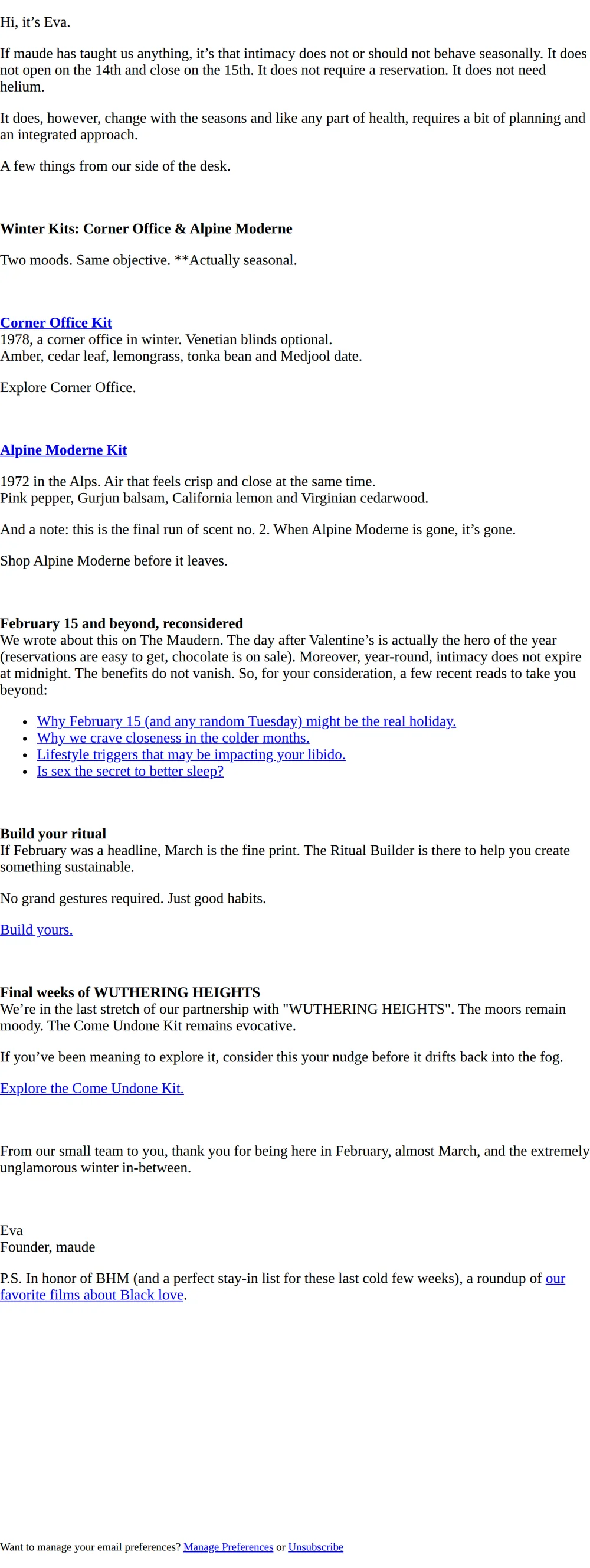
Intimacy isn't seasonal
Pattern: intimacy doesn't expire on February 15th.
Use it here: A quieter, more human note can invite an explicit preference signal; use it to clarify consent and relevance, not to disguise continued pressure.
Open reference in new tab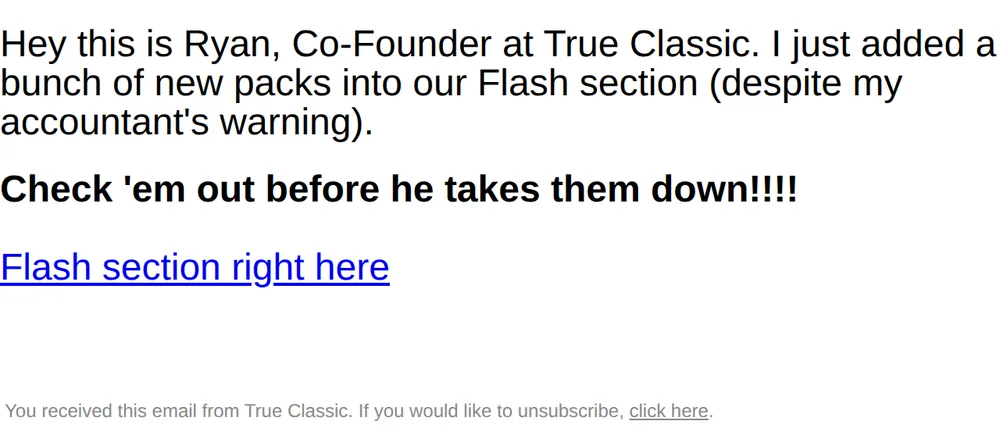
Please don’t tell my finance team
Pattern: Founder added deals despite accountant's warning.
Use it here: A direct final message needs a real sender voice and a clear consequence; do not invent a deadline merely to force a dormant profile to engage.
Open reference in new tabCreative and design curation only. These are role references, not reported revenue, conversion, or a promise that the exact tactic will transfer unchanged.
Need help implementing this?
We build and manage complete email & SMS programs for DTC brands. Get a custom plan for your brand.
Get Your Free Audit + Gameplan