The VIP & Loyalty Flow: Reward Your Best Customers
Build a clear, rolling VIP recognition journey around a documented customer definition, meaningful benefits, and an experience worth maintaining.
- Build the trigger, timing, branches, and exits for this flow
- Measure and improve the flow against a stable cohort
What is a VIP flow, and why do your best customers need one?
A VIP flow is a separate recognition journey for a clearly defined high-value customer cohort. It gives the brand a way to acknowledge loyalty with status, access, or service that genuinely fits the economics. There is no universal percentage of buyers, lifetime-value multiplier, or perk that defines VIP status.
Define VIP status from a documented customer rule, such as lifetime spend, repeat behavior, margin contribution, engagement, or a platform model you have reviewed. Keep it rolling, explain the status clearly, and test whether access, service, gifts, or pricing actually creates value for the customer and the business. Thank first; do not turn VIP status into a generic discount list.
Treating a high-value repeat buyer exactly like a first-time customer can miss an opportunity for relevant recognition. The right experience should be defined from the brand's customer economics and actual benefits, not copied from a loyalty trope.
Here is what treating a VIP like a VIP looks like in practice.

For a related operating model, see the post-purchase flow: the VIP journey should complement the post-purchase experience rather than duplicate it.
How do you define a VIP customer segment?
Define a VIP segment with a rule that matches the reason you want to recognize the customer: sustained spend, repeat behavior, contribution margin, strategic product adoption, or a platform model you can explain. This is a natural extension of your broader email segmentation strategy. Start with the simplest rule your team can audit, then add complexity only when it changes a meaningful decision.
You cannot reward a group you have not drawn a line around.
Pick one of these three definitions and build a segment from it.
How do you define a VIP customer segment
- 01Lifetime contribution
Use a documented spend or margin rule when historical contribution is the reason for the benefit.
- 02Repeat behavior
Use a defined order, subscription, or category behavior when consistency matters more than a single large purchase.
- 03Reviewed model signal
Use a platform or internal prediction only when the team understands its inputs, limitations, and the action it changes.
ZHS decision framework. Choose the simplest definition that makes the benefit and its economics clear.
Start with the rule your team can explain at a glance. Review it periodically to make sure it still identifies the cohort the benefit was designed for.
Build VIP status as a rolling segment, not a one-time export. People should enter when they cross the line and exit if they go quiet, so the flow always reflects who your best customers are right now.
What should a welcome-to-VIP email do?
Trigger a flow the second someone qualifies, and do three things. Name the status plainly so they know they made the cut. Explain the perks they now get access to, so it feels like a door opening. Set the tone as a thank-you, not a sale. The sale is the reward they already earned.
The moment someone crosses into VIP is the moment to make them feel it.
Do not let it pass silently. Trigger a flow the second they qualify.
View full build
Read the text version
Trigger: When someone enters the canonical VIP segment
Entry filters: Entered the canonical VIP segment; Can receive marketing
Exit conditions: No longer qualifies for VIP treatment; Cannot receive marketing
Re-entry: One welcome per VIP qualification period
- email: Email 1You made the cut: status and benefits
- sms: SMS 1Personal VIP welcome
- delay: Wait 2 days
- email: Email 2Early access and concierge-style help
- delay: Wait 5 days
- email: Email 3Curated next purchase based on history
-
Name the status. Tell them plainly they are now a VIP, a top customer, an insider. People like being told they made the cut.
-
Explain the perks. List what they now get access to. Make it feel like a door opening, not a coupon landing.
-
Set the tone. This is a thank-you, not a sales email. The sale is the reward you already earned.
What should a welcome-to-VIP email do
- 01Trigger: They Cross The LineEnters The VIP Segment
The rolling segment picks them up the moment they qualify. No manual export, no waiting for someone to notice.
- 02ImmediatelyWelcome-To-VIP Email
Name the status, list the perks they now get, and make it read as a thank-you. The sale is the reward they already earned.
- 03From Then OnInsider Access
Early access to drops and restocks, first dibs before public sales. VIPs hear the news before the main list does.
Structured from the canonical article steps for responsive reading and presenter mode.
Should you give VIPs discounts or perks?
Choose a benefit that reinforces the reason for VIP status. Access, service, gifts, recognition, and pricing can all be valid; none is universally best. Test the benefit against customer response, incremental margin, fulfillment cost, and the risk of training customers to delay purchase.
A discount is what you give everyone during a sale. Status is what you give the people who earned it.
The difference matters, because a VIP who only ever gets a bigger coupon learns to wait for the coupon.
- Same broadcast as everyone else
- Generic percent-off codes
- Waits in line for restocks and drops
- No acknowledgment of past spend
- Reactivated only when they lapse
- Early access to new products and drops
- Free gift or upgrade with their next order
- First dibs before the public sale opens
- A real thank-you that names their loyalty
- Birthday and anniversary touches
Early access can work when it is genuinely scarce or useful. A gift can work when it is economically responsible. A discount can work when it is a deliberate part of the offer strategy. State the intended behavior and measure the result instead of assuming one benefit wins.
Should you send birthday and anniversary emails?
Use birthday or anniversary messages only when the data was collected transparently, the timing feels welcome, and the benefit is meaningful enough to justify the contact. They can be useful recognition moments, but they are not automatic wins and should not become a reason to request unnecessary personal data.
If you collect an optional birthday, explain why and provide a clear preference path. An anniversary can be derived from an existing purchase record, but still needs a message that feels relevant to the customer rather than mechanically timed.
Should you send birthday and anniversary emails
- 01On Their BirthdayBirthday Gift
Collect the birthday in your popup or profile update, then send a real perk on the day. A gift or early access, not just "happy birthday."
- 02One Year After First OrderCustomer Anniversary
Thank them for a year, recap what they bought, and hand them something for sticking around. It reads as loyalty, not a sales push.
Structured from the canonical article steps for responsive reading and presenter mode.
How do you keep VIPs feeling like insiders?
Keep the access flowing between the big moments, because status fades if you only touch it once a year. Give VIPs the news first on drops, restocks, and collabs. Ask their opinion on what to make next. Skip the friction with free shipping or priority support. And send fewer, better emails, not more volume.
Status fades if you only touch it once a year.
The point is to make VIP membership feel ongoing, so keep the access flowing between the big moments.
- Give them the news first. New drops, restocks, and collabs should hit VIPs before the main list.
- Ask for their opinion. A short "what should we make next" email tells a VIP their voice counts.
- Skip the friction. Free shipping, priority support, or an easy return path. Small, but it signals they are handled.
- Send fewer, better emails. VIPs do not need more volume. They need messages that feel meant for them, which also protects your sender deliverability.
What are the most common VIP flow mistakes?
The five that cost the most: having no VIP segment at all, sending discounts instead of status, running a static list that goes stale, ignoring birthdays and anniversaries, and treating VIP as a pure promo list. Fix the first one by drawing the line and building the segment. The rest follow from thanking first and selling second.
-
No VIP segment at all. Your best customers get the same blasts as one-time buyers. Draw the line and build the segment first.
-
Discounts instead of status. A bigger coupon trains VIPs to wait. Lead with access and gifts, save price cuts for real sales.
-
A static list. Exporting VIPs once means the segment goes stale. Keep it rolling so people enter and exit on real behavior.
-
Ignoring birthdays and anniversaries. These are free, personal, and high-open. Collect the dates and use them.
-
Treating VIP as a promo list. If every VIP email sells, the status feels fake. Thank first, sell second.
Get Expert Help
Our team finds your highest-value customers, defines the right VIP segment, and builds the flow that keeps them buying. We handle the segmentation, the perks strategy, the copy, and the technical setup so your best customers feel like insiders.
More patterns to study
Curated creative references for this lesson. Study the mechanism, then adapt it to your own audience, offer, and evidence.
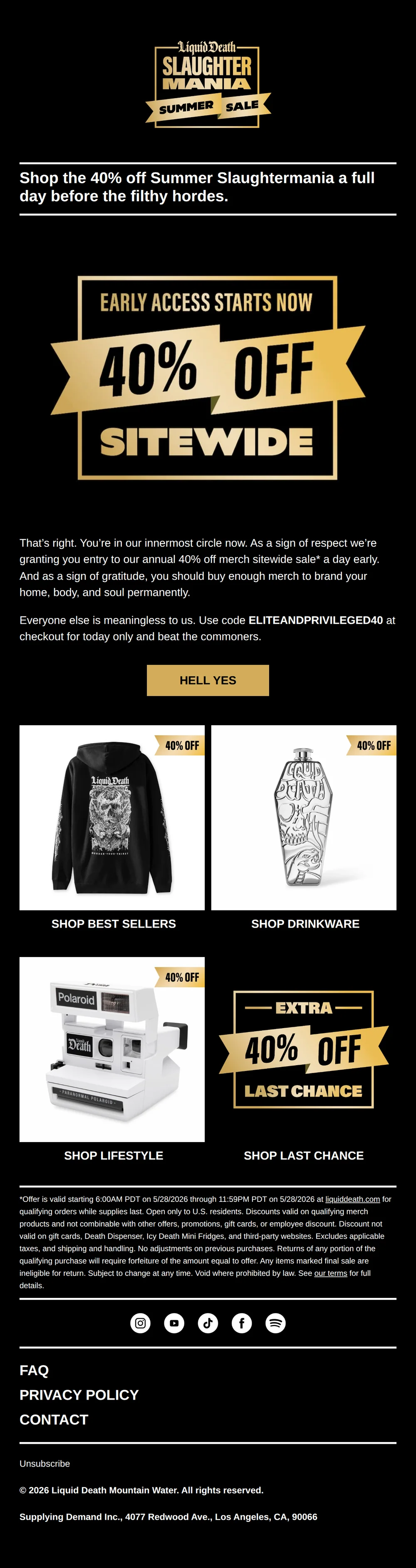
EARLY ACCESS: 40% Off Merch Sitewide
Pattern: Early access sale for the inner circle only.
Use it here: Early access feels valuable when eligibility is real and the audience understands what access they earned; do not make exclusivity a vague label.
Open reference in new tab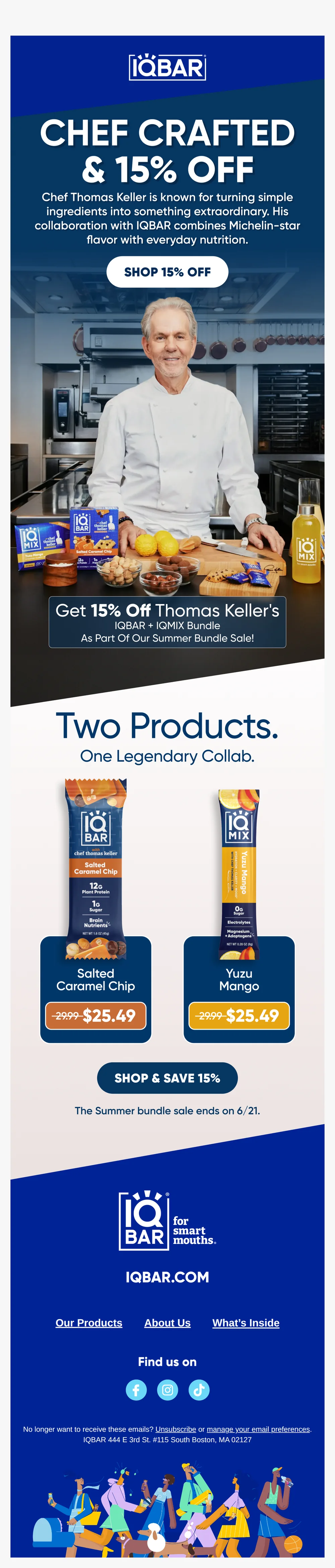
Michelin-star flavor. 15% off. 🍫
Pattern: Michelin-star chef collab legitimizes nutrition bar brand.
Use it here: A credibility-led perk or collaboration can reinforce status when it fits the customer's prior behavior and the brand's actual loyalty proposition.
Open reference in new tabCreative and design curation only. These are role references, not reported revenue, conversion, or a promise that the exact tactic will transfer unchanged.
Need help implementing this?
We build and manage complete email & SMS programs for DTC brands. Get a custom plan for your brand.
Get Your Free Audit + Gameplan