The Review Request Flow: Turn Buyers Into Social Proof
Build a review request flow that asks eligible buyers for honest feedback after a documented product-use window.
- Build the trigger, timing, branches, and exits for this flow
- Measure and improve the flow against a stable cohort
What is a review request flow?
A review request flow asks verified buyers for an honest account of their experience after they have had enough time to use the product. It coordinates the review platform, delivery or fulfillment signal, reminders, support response, incentives, disclosure, and downstream permission to reuse customer content.
Customer proof can make a marketing claim easier to evaluate when it is genuine, specific, representative of the experience being described, and used with the appropriate permission.
Reviews, photos, before-and-afters. That is the content that makes your welcome flow land, your cart recovery close, and your campaigns sell without a discount.
Instead of leaving collection to chance, define an eligible audience, one notification owner, a documented product-use window, and a review path that works on mobile.
Here is what one looks like.

Choose one system to own the request, trigger from a verified delivery event when available or a documented fulfillment-plus-transit delay, and wait long enough for real product use. Ask every eligible buyer for honest feedback through the same review path. Offer support separately without steering unhappy customers away from public review. Follow the chosen platform's incentive rules and disclose any permitted material benefit.
Review and testimonial law plus platform policy can change. The FTC permits some non-sentiment-conditioned incentives with appropriate disclosure, while a review platform such as Google may prohibit incentivized reviews entirely. Have counsel and the destination platform approve the program.
Why do you need a separate review request flow?
Because a review email inside a post-purchase flow does not by itself define the owner, timing, exclusions, permission, or reuse process. A dedicated review flow can make those controls explicit and create a reliable intake path for stories that the team has permission to reuse.
One review email inside a post-purchase flow can be a useful start, but it does not replace a documented request system.
A dedicated review request flow gives you a repeatable machine that feeds every other channel you run.
One approved customer story can support several placements: a quote graphic for a campaign, a before-and-after for social proof, a photo for cart recovery, a case study for a nurture email, or a testimonial in the welcome flow. Choose the placement that matches the story and the reader's objection.
You are not creating more work. You are getting more mileage out of customer content for your emails that they hand you for free.
When should you send a review request email?
Trigger from a verified delivered event when the shipping or review integration provides one. Otherwise use Fulfilled Order plus a documented transit delay and product-use delay. Timing depends on the product: apparel may need days after delivery, while supplements, skincare, or durable products may need weeks before an honest outcome can be described.
Ask too early and they have not opened the box. Ask too late and the excitement is gone.
Start from delivery when possible, then wait through the documented product-use window before the first request. The right window should reflect the product, shipping reality, and the kind of feedback you are asking buyers to provide.
View full build
Read the text version
Trigger: When the order is delivered
Entry filters: Delivered or product-appropriate fulfillment window reached; Eligible buyer under the destination platform policy
Exit conditions: Review submitted; Order refunded, cancelled, or otherwise ineligible
- delay: Wait 7 to 14 days
- email: Email 1Review request
- sms: SMS 1Review request
- delay: Wait 3 to 5 days
- email: Email 2Founder 1:1 check-in
The chart shows the core delivered-review sequence. The rating-based branch covered further down is an optional refinement you layer on top of it.
Do not automatically fire email and SMS together. Assign one primary review ask, then add a consented second channel only when it has a distinct job and account-wide pressure allows it. A reminder can use a simpler founder-style format, but it must still preserve required identification, opt-out, and review-policy behavior.
Okendo, Junip, Judge.me, Loox, Yotpo, Stamped, and other review tools can own the ask or send an event into Klaviyo. Inventory native and Klaviyo notifications before launch. If both systems send the same job, disable one and test the cutover with a real order.
Review request build and QA
- One system owns each review notification job
- Delivered event or fulfillment-plus-transit logic is documented
- Product-use delay matches the category
- Every eligible buyer receives the same honest review path
- Recent reviewers exit future reminders
- Refunded, cancelled, fraudulent, and undelivered orders are excluded
- Email and SMS eligibility are evaluated separately
- Review destination and deep link work on mobile
- Photo and video reuse permission is explicit
- Support escalation is available without replacing the review path
- Any incentive is permitted by the destination platform
- Permitted incentives are not conditioned on sentiment
- Required material-connection disclosure is clear
- Test orders prove trigger, reminder, exit, and duplicate suppression
Previewing the template is not enough; prove the event, destination, suppression, and destination-platform policy with a real test path.
How do you write a review request email that converts?
Give the request a clear primary action. If you add a follow, a coupon, or a survey, treat it as a deliberate tradeoff and test whether it distracts from the review path. Then invite the customer to share context: the problem, what changed, and what the result looks like. A before-and-after can be useful when it credibly shows the relevant experience.
For a focused request, use one primary question and one primary action.
Do not assume a second ask helps. Keep the review path easy to understand, and test any additional request against a version with the review as the only primary action.
Then push past the star rating. Ratings are a useful starting signal, but they do not always explain the experience behind the score.
Ask for the story: what problem were they dealing with, what changed, and what does it look like now. A specific account can be more useful than an isolated rating when it answers a real buyer objection.
A star rating gives you one signal. A customer photo or video may be useful creative when the customer has agreed to that use. Offer an upload path only when the review destination, consent language, moderation process, and intended reuse are clear.
How do you handle unhappy customers without review gating?
Send every eligible buyer to the same honest review opportunity regardless of predicted sentiment or a private pre-rating. Provide a visible support path to everyone and respond quickly when a customer reports a problem, but do not route low ratings away from the public destination while sending high ratings there. That is review gating and can distort the represented review population.
Not every customer is glad they bought. That is fine, as long as you catch it before it becomes a public one-star.
Ask for honest feedback first. Support can branch after the submission or through a separate help action available to every buyer.
- Offer the same destination to every eligible buyer
- Prompt for a photo or short video
- Thank them and make them feel seen
- Invite them into your UGC pipeline
- Make support available without replacing or blocking the review path
- Offer a real fix, a swap, or a refund
- Solve the issue without conditioning help on changing a review
- Turn the save into loyalty
The customer can review and request help. Those rights are not mutually exclusive.
Where should you use the reviews you collect?
Use approved reviews where they answer a specific decision point. A review may help orient new subscribers in the welcome flow, address hesitation in cart recovery, reinforce a post-purchase decision, support a customer-story campaign, or direct readers to a success hub. The reuse plan should match the proof, permission, and reader context.
A review on a product page serves a different job from a review selected for an email or campaign.
Once the reviews come in, deploy them everywhere.
- Welcome flow. Show new subscribers what is possible before they have bought anything.
- Cart and checkout recovery. Use social proof in your cart recovery flow to push through the hesitation that stalled the purchase.
- Post-purchase. Reinforce the smart decision they just made with other buyers' results.
- Campaigns. Build a "what customers say" email around your best transformation stories.
- Success hub. Point a page on your site at your strongest stories, then drive email traffic to it.
The flow creates a governed collection path; approved reviews can then become inputs to other relevant lifecycle content.
What are the most common review flow mistakes?
Common failure modes include asking before product use, duplicate sends from two systems, stacking unrelated jobs, requesting content without reuse permission, using prohibited or undisclosed incentives, and review gating. Each can damage trust, data quality, or platform standing.
-
Asking before product use. If the box has not landed or the product has not had time to be used, the request is poorly timed. Trigger from delivery when possible, then wait through the documented product-use window before the first ask.
-
Duplicate notification owners. Review-app and Klaviyo sends can collide. Assign one owner per message job.
-
Stacking multiple asks. A review request that also pushes a follow, a coupon, and a survey can obscure the primary task. Keep the review path clear and test additions intentionally.
-
Settling for star ratings. A rating can be useful, but a written story or photo may offer more context when the customer has permissioned the intended use.
-
Ignoring destination incentive policy. The FTC rule and a review platform can impose different requirements. Google prohibits incentivized reviews; never assume a sentiment-neutral perk is accepted everywhere.
-
Review gating. Do not send predicted-positive reviewers public while diverting predicted-negative reviewers to a private form. Ask everyone honestly and make support available to everyone.
Get Expert Help
Our team builds review request flows with documented timing, routing, exclusions, and reuse controls, then helps place approved customer proof in welcome, cart, and campaign emails.
More patterns to study
Curated creative references for this lesson. Study the mechanism, then adapt it to your own audience, offer, and evidence.
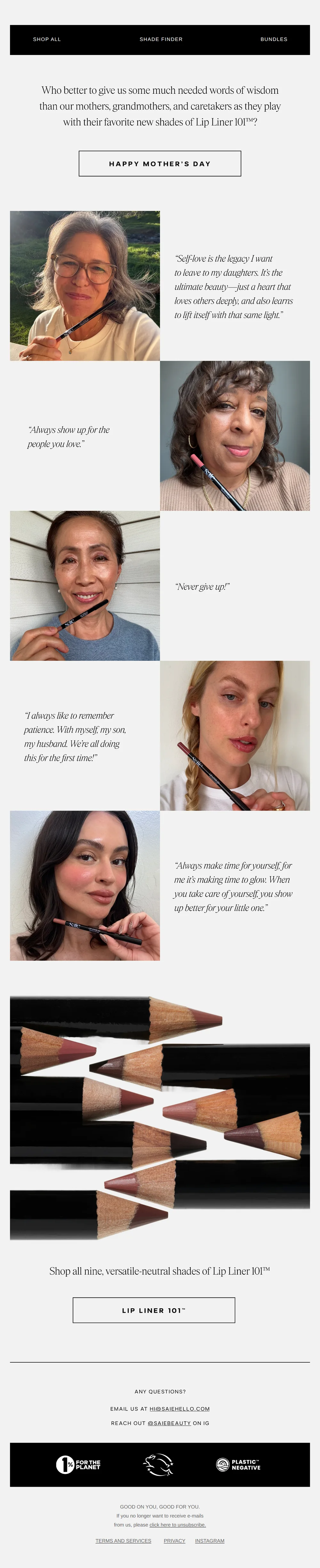
Wisdom 101
Pattern: Real moms share wisdom while modeling lip liner.
Use it here: Customer perspective is more useful when it includes a real situation or routine; use only content you are permitted to display and attribute.
Open reference in new tab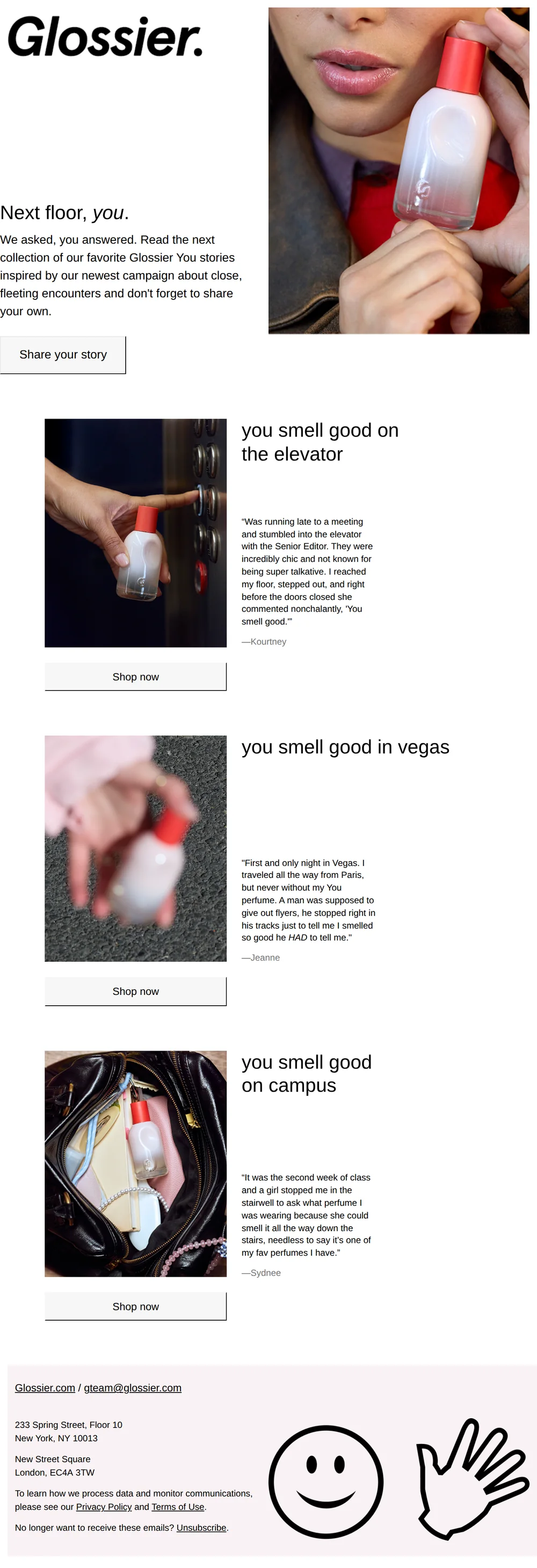
Going up?
Pattern: Real customer scent stories make fragrance irresistible.
Use it here: A buyer story can answer an objection more naturally than a brand claim, but review, consent, and disclosure rules still govern the placement.
Open reference in new tabCreative and design curation only. These are role references, not reported revenue, conversion, or a promise that the exact tactic will transfer unchanged.
Need help implementing this?
We build and manage complete email & SMS programs for DTC brands. Get a custom plan for your brand.
Get Your Free Audit + Gameplan