How to Use Customer Stories and UGC in Your Emails
Use approved customer reviews, photos, and stories to address specific reader questions in email without overstating what proof can establish.
- Plan the campaign using the framework in this lesson
- QA the offer, audience, creative, and measurement plan
Why does customer proof beat your own claims?
Customer proof can reduce skepticism when it lets readers evaluate a buyer's experience rather than rely on the brand's assertion alone. It needs to be genuine, specific, appropriately permissioned, and kept near the question it helps answer.
Customer proof is most useful when the account is genuine, specific, representative enough for the claim being made, and clear about any material connection. When a customer describes the problem, the product experience, and the result in their own terms, readers can better judge whether it is relevant to them.
Invite customers to share the context that makes a story useful: the problem, their product experience, and the result. An approved story may support a quote graphic, photo, case study, dedicated campaign, or success-hub section when the placement fits. Put proof near a real buyer question, for example, in welcome, abandonment, or post-purchase messages, rather than assuming one format works everywhere. A before-and-after can be compelling when it is genuine, appropriately disclosed, and relevant to the reader's decision.
Treat review-platform terms, the customer's consent, and the intended channel as separate checks. Preserve the customer's meaning, disclose any material connection that applies, and have qualified counsel assess rights, substantiation, and disclosure requirements for your use case.
A review collection process can stop at a pile of star ratings unless the team has a clear way to select, permission, and place richer customer stories.
Teams with a disciplined proof program treat customer stories as a reusable input to their email strategy, not as content that only lives on a reviews page.
Here is why it works.
When you say your product is great, readers know the claim comes from the seller.
When a customer describes a product experience in their own words, readers can compare that experience with their own situation, provided any material connection is disclosed.
A real story can add context that a feature list alone does not provide.
Here is what this looks like in practice.

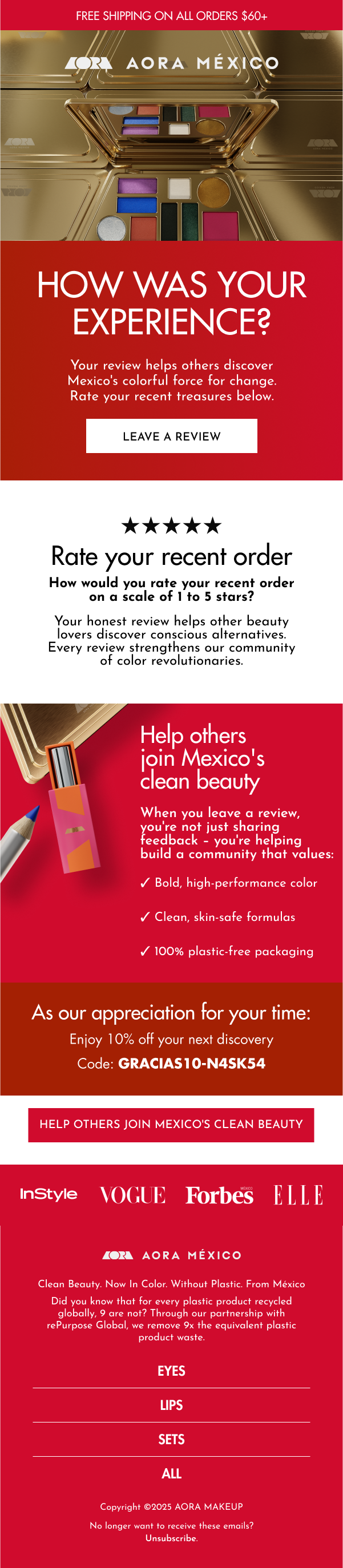
What is the difference between brand claims and customer proof?
The difference is who is talking. A brand claim like "our formula is the best" reads like every other ad, so it gets skimmed. Customer proof like "I tried three things before this finally worked" sounds like a real person, so it gets read. One lists features. The other shows a problem, a fix, and a result.
The same message lands completely differently depending on who says it.
Your job is to stop being the only voice in the inbox.
- "Our formula is the best on the market"
- May read as promotional without supporting evidence
- Can leave a reader's practical questions unanswered
- Lists features and benefits
- May not resolve the reader's specific objection
- "I tried three things before this finally worked"
- Can add a buyer's perspective
- Can make the situation easier to compare
- Shows a problem, a fix, and a result
- Helps readers judge whether the experience is relevant
What types of UGC should you collect for email?
Useful formats include reviews, photos, before-and-after documentation, testimonials, and founder-adjacent stories. Choose the format that can honestly show the relevant experience; a before-and-after should be genuine, contextualized, and appropriate for the claim. For every format, invite the customer to share the journey, not just a rating, when the review destination and permission process support it.
Not all proof answers the same question. A rating can show a broad signal; a specific story can explain the context behind it.
Ask your customers for the whole journey: the problem they had, the fix you gave them, and the result they got.
- Reviews. Fast to collect and easy to drop into a template. Pull the specific ones, not the generic "great product" line.
- Photos. A real customer using the product can add useful context when the image is authentic and approved for the intended use.
- Before and after. Use this format when it can fairly show the experience without implying an outcome the product cannot substantiate.
- Testimonials. A few sentences in a customer's own words. Use them as quote graphics that break up a heavy sales email.
- Founder-adjacent stories. Why the product was built and who it was built for. This gives the proof a reason to exist.
Where should you put customer proof in your emails?
Consider customer proof in high-intent surfaces such as the welcome flow, abandoned cart, and post-purchase sequence. Select a story only when it addresses the reader's likely question and the claimed outcome is supportable. Keep proof in the flows and campaigns where that context is useful, not only on a reviews page.
Proof works hardest when it shows up at the moment of doubt.
Put customer stories in your most important flows and campaigns, not on a reviews page nobody visits.
Where should you put customer proof in your emails
- 01Welcome flowOrient a new subscriber
Use an approved story when it answers a question a new subscriber may have about the product or brand.
- 02Abandoned cartAddress a documented hesitation
Select proof that speaks to the objection or uncertainty evident in the cart experience.
- 03Post-purchaseReinforce the customer experience
Use relevant customer context to help a new buyer understand how others use or evaluate the product.
Structured from the canonical article steps for responsive reading and presenter mode.
You can also build a whole campaign around one customer. Tell their situation, their doubt, and their result.
These success-story campaigns can support a value-led message without leading with a discount when the story is relevant, approved, and responsibly framed.
| Proof type | Best placement | Why it fits |
|---|---|---|
| Before and after | Campaign, welcome flow | Shows the outcome the reader wants |
| Review quotes | Abandoned cart, campaigns | Answers the objection at the moment of doubt |
| Customer photos | Post-purchase, social proof blocks | Adds use-context when authentic and permissioned |
| Full customer journey story | Dedicated success-story campaign | One story carries a whole send |
| Founder-adjacent story | Welcome flow | Gives the brand a reason to trust |
How do you get more mileage from one customer story?
Ask for the full story once, then decide whether approved elements can be adapted into a quote graphic, social-proof photo, nurture case study, dedicated campaign, or customer-success hub. Reuse should preserve the customer's meaning and match the permission granted for each placement.
Here is the part most brands miss.
You are not creating more work. You are getting more mileage from work your customers already did for you.
Ask for the full story once, then adapt only the approved parts that remain meaningful in the new placement.
An approved before-and-after story may support a quote graphic, social-proof photo, nurture case study, dedicated campaign, or customer-success hub section. Match the use to the consent, context, and strength of the underlying evidence.
How do you get more mileage from one customer story
- 01PlacementQuote graphic
Use a specific approved line when it helps answer the email's primary question.
- 02PlacementSocial-proof photo
Use a real customer image only when it is authentic and approved for the intended channel.
- 03PlacementCase study
Preserve the full problem, product experience, and result when the longer context is useful.
- 04PlacementSuccess-story campaign
Build a send around the customer's situation and result without extending the claim beyond the evidence.
- 05PlacementSuccess hub section
Add the story to a hub when the permission and surrounding context remain clear.
Structured from the canonical article steps for responsive reading and presenter mode.
Build a success hub only if it helps readers evaluate the product, and link to it when a customer story is relevant to the email's purpose.
Email is the most underrated distribution channel you already own. Use it to push your best proof instead of letting it sit unseen.
Well-selected customer stories can make a sales message more informative, but measure their contribution rather than assuming a direct conversion effect.
What are the most common UGC email mistakes?
Common UGC-email mistakes include collecting only star ratings, leaving proof on a reviews page, using generic quotes, adapting a story without preserving its context, and never asking customers for feedback. Address them with a clear collection path, specific approved excerpts, and intentional placements in the lifecycle.
- Collecting only star ratings. Ask for the problem, the fix, and the result, not just a number out of five.
- Leaving proof on a reviews page. Move it into the flows and campaigns where buyers actually hesitate.
- Using generic quotes. A generic compliment may not answer a buyer question. Prefer a specific approved line that names the relevant objection or use case.
- Reusing a story without context. Adapt an approved story only when the new format still represents the customer's experience fairly.
- Never asking. Give eligible customers a clear, honest route to share feedback through a review request in your post-purchase flow.
Get Expert Help
Our team helps teams collect, permission, and place customer proof across the flows and campaigns where it can answer a relevant buyer question.
More patterns to study
Curated creative references for this lesson. Study the mechanism, then adapt it to your own audience, offer, and evidence.
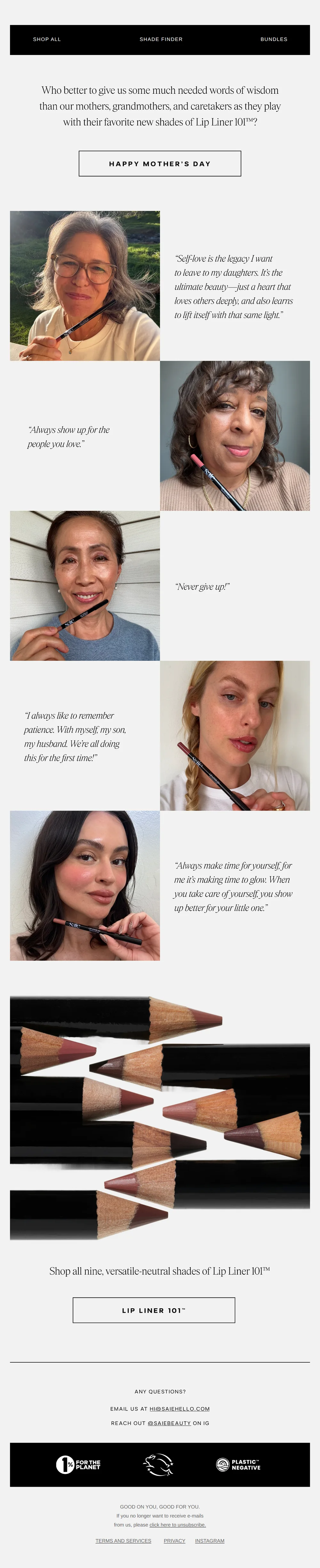
Wisdom 101
Pattern: Real moms share wisdom while modeling lip liner.
Use it here: Let customer perspective add a recognizably human point of view, then secure the rights and disclosures needed for the exact placement.
Open reference in new tab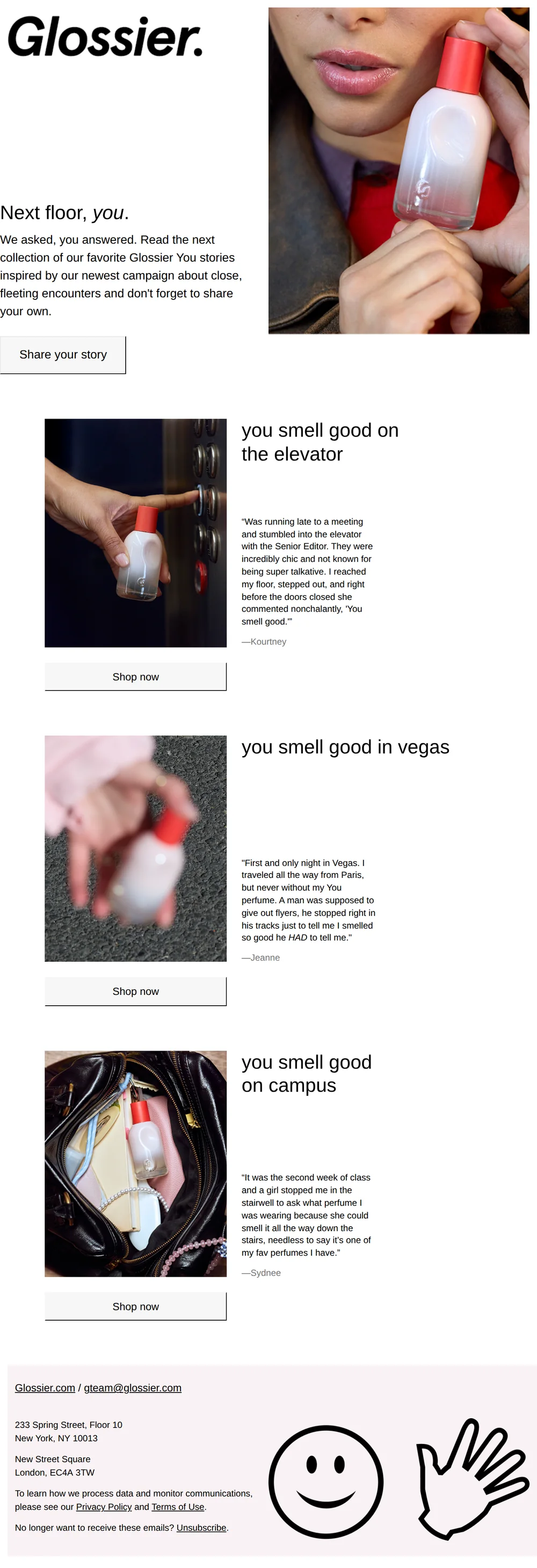
Going up?
Pattern: Real customer scent stories make fragrance irresistible.
Use it here: Customer stories are strongest when they answer a practical reader question; preserve the person's meaning instead of manufacturing a testimonial.
Open reference in new tabCreative and design curation only. These are role references, not reported revenue, conversion, or a promise that the exact tactic will transfer unchanged.
Need help implementing this?
We build and manage complete email & SMS programs for DTC brands. Get a custom plan for your brand.
Get Your Free Audit + Gameplan