How to Drive Sales Without Discounting
Discounts train your list to wait and crush your margins. Learn the campaign angles ZHS uses to sell at full price: education, story, social proof, and urgency that is real.
- Plan the campaign using the framework in this lesson
- QA the offer, audience, creative, and measurement plan
Why is discounting the wrong default for email?
Discounting is the wrong default because a predictable sequence of codes can compress margin and teach customers to delay full-price purchases. Build the reason to act from product value, education, proof, launches, restocks, or honest scarcity before reducing price.
Discounting is the wrong default because repeated, predictable codes can train customers to wait and compress margin. ZHS uses education, product stories, social proof, launches, restocks, and honest scarcity to create reasons to send at full price. The operating principle is simple: expand the number of useful angles before expanding the discount depth.
You do not need a discount to drive sales. Build campaigns on eight non-promo angles like education, product story, social proof, and real scarcity instead of price. Use value-based emails that teach or entertain to prime your list before you sell. Run the micro-idea system, one email per idea, to ship 1,000-plus ideas a month. When a customer needs a deal, offer free shipping or a same-price bundle, never a percentage-off code.
Most brands have one lever. When they want a sale, they discount.
It works once. Then it trains your list to wait for the next promo, and your full-price sends quietly stop converting.
Discounting is the easy move. It is also the one that erodes margin and teaches your best customers to sit on their hands until the next code drops.
I talk to more than 25 brands a week, and this is where most go wrong. They think every single email has to push a sale. Buy this now. Only 12 left. Flash sale ends at midnight. That is the entire program.
Those emails work. But if that is ALL you send, your list churns fast and you burn it out before you ever capture its real value.
High campaign volume only works when it comes from distinct customer reasons, not the same code repeated with new subject lines. The campaign cadence playbook turns those reasons into a controlled schedule with audience and fatigue checks.
Here is what full-price selling looks like in practice.
Rather see it on camera? Watch the video version:

What is the difference between discount-dependent and full-price selling?
Discount-dependent selling hangs every campaign on a code, which trains buyers to wait and shrinks margin on each promo. Full-price selling pulls scarcity, story, and proof so buyers act because they want the product now. One approach makes revenue feel random. The other keeps growth predictable with margin intact.
The problem is not the occasional promo. It is building your entire calendar on price.
Once a code appears in every send, the code becomes the offer, and everything else you make gets ignored.
- Every campaign hangs on a code
- Trains the list to wait for the next sale
- Full-price sends stop converting
- Margin shrinks with each promo
- One tool, so revenue feels random
- Campaigns pull scarcity, story, and proof
- Buyers act because they want the product now
- Full-price sends keep working
- Margin stays intact
- A whole toolkit, so growth is predictable
The brands most addicted to the promo calendar are the ones whose full-price emails stopped converting. That is not a coincidence. It is cause and effect.
How do value-based emails sell without selling?
Value-based emails sell without selling because they teach, entertain, or educate, which warms the list so your next sales send lands. They show off the product naturally, so the customer has to buy to make the mocktail or copy the look. Blend value and sales and you get a real lift in opens, engagement, and revenue.
Not every email needs to be a direct sales push. Some of your best performing campaigns should be value-based: the ones that teach, entertain, or educate.
I know that sounds backwards. Here is why it works.
They prime the list. A warm, engaged reader is already excited to open your emails. So when you DO send a sales send, they are primed and ready to buy.
They sell without selling. You show off the product naturally, get people excited about the brand, and help them out. These are emails someone would forward to a friend, and they lean on the same email copywriting fundamentals that make any send readable.
They lift the whole program. Blend value and sales and you see a real, incremental lift in open rates, engagement, and revenue.
Here is a beverage example. Breeze sends mocktail recipes. Each email shows you how to make the drink, and to make it you need the product. It is a value-based email that subtly sells. They even ran a "March Madness, mocktail edition" bracket where people submitted recipes and voted, which meant buying the product to test them.
That same move works anywhere:
- Makeup brand. How to recreate a celebrity look, or which products combine into one specific look.
- Jewelry brand. How to stack necklaces, what pairs with what, how to keep it from tarnishing.
- Supplement brand. Answer the FAQs. If you sell creatine, is 5 milligrams a day enough or should it be 10? What does the science say? Every FAQ is an email.
None of those pitch a discount. They still drive sales, because people have to buy the product to make the mocktail or copy the look.
When I come up with campaign ideas, I ask one question: would I share this with a friend on Instagram? Is it helpful, funny, a relevant piece of news, or a how-to they are looking for? If yes, it is an email. If no, it is filler.
How do you come up with 1,000 email ideas a month?
You come up with 1,000-plus ideas a month with one rule: one email, one idea. Every tiny element on your site, social, and ads is a micro idea you blow up into a single email. One ingredient, one product, one blog post, one social post. You are not reinventing anything, you are using what you already have.
The reason we can ship 150-plus campaigns a month is a simple rule. One email, one idea.
Every tiny element on your website, your social, and your ads is a "micro idea" you can blow up into a single email. You are not reinventing anything. You are using what you already have.
- One ingredient becomes one email. Why is that ingredient in the product, what makes it different, why did you pick it. AG1 runs this exact ingredient-highlight play, with a subscription CTA up top.
- One product becomes a product-story email. For a client's bourbon we distilled everything unique about it into one send: Kentucky straight bourbon with a twist, Chardonnay cask finished, tasting notes on aroma, flavor, and finish, plus social proof. That is a full-price product story, no code.
- Everything else is an email too. New blog post, new social post, new collection, industry news, behind the scenes. Each one is its own send.
Here is one product turned into six separate sends, all from material you already have.
How do you come up with 1,000 email ideas a month
- 01One ingredientIngredient spotlight
Why that ingredient is in the product, what makes it different, why you picked it.
- 02One productProduct story
Distill everything unique into one send: how it is made, the details, the social proof.
- 03One FAQAnswer a question
Every question customers ask about the product is its own email. What does the science say?
- 04One blog postRepurpose the content
The post already exists. Blow it up into a send instead of letting it sit on the site.
- 05One social postRemix what worked
A post that performed on social is a proven idea. Turn it into an email of its own.
- 06Behind the scenesShow how it is made
Industry news, a new collection, a look inside the process. Each one is a separate send.
Structured from the canonical article steps for responsive reading and presenter mode.
And you can remix. If you sent a great email last summer, no one will notice if you send it again. Subscribe to competitor lists, see what is working, and do it a little better for your brand.
The one rule you cannot break: one email, one topic. I would rather send four short emails on four singular topics than one long newsletter cramming all four together. Nobody reads the 1,500-word essay.
What are the best non-discount email campaign ideas?
There are eight non-discount campaign angles that sell at full price: education, product story, founder POV, social proof and UGC, scarcity and new arrivals, behind the scenes, real urgency, and bundles. Each one gives buyers a reason to act without a code, and each holds dozens of variations inside it.
You do not need a discount to earn a click and a sale. You need a reason.
Here are the angles we build full-margin campaigns around, each pulled from real DTC sends. Social proof leans hardest on customer stories and UGC in email, while scarcity and new arrivals map straight onto how you run a product launch or drop.
| Campaign type | What it does | Example angle |
|---|---|---|
| Education | Answers the "does it really work" objection | The science that backs it up, myths debunked |
| Product story | Builds desire through how it is made | Behind the scenes, deep dive on your best-seller |
| Founder POV | Sells the worldview before the product | Why the brand exists and who it helps |
| Social proof / UGC | Lets customers do the selling | Video reviews, before and after, UGC roundup |
| Scarcity and new arrivals | Creates real urgency without a code | Final run, restock, early access to a launch |
| Behind the scenes | Makes the brand feel human | A day in the life, staff picks, how it is made |
| Real urgency | A deadline that is actually true | One final run, gone for good, pre-order first-come |
| Bundles | More value at the same price | Build your own kit, perfect pairings |
That is eight distinct angles, with dozens of variations inside each.
When a code is off the table, your creativity is the only ceiling.
What can you use instead of a discount to drive urgency?
Five levers beat a code: cultural relevance, scarcity, outcome-led copy, a strong point of view, and genuine education. Trend-jack to stop the scroll, frame a real final run with a true deadline, lead with the result, sell the worldview first, then teach post-purchase. Stack those and you create urgency without ever cutting price.
We pulled five emails from real clients. Not one leaned on a discount.
Here is the lever each pulled instead.
What can you use instead of a discount to drive urgency
- 01Cultural relevanceTrend-jack, then reframe
Hijack a trending term to stop the scroll, then reframe it to your brand's point of view so you get the clicks without the baggage.
- 02ScarcityFinal run plus a deadline
A restock or "final run" framed with demand proof and a real deadline is a full-margin campaign. You never have to discount to create urgency.
- 03Outcome-led copyResult first, mechanism second
Lead with the result your product creates. Save the "how it works in 3 steps" block for lower down, backed by proof visuals.
- 04Point of viewSell the shift, then the product
For a high-consideration or new-category product, sell the worldview first. Then stack risk reversal, like a 30-day guarantee, to close the gap.
- 05EducationHelp instead of sell
Post-purchase and win-back emails do not have to pitch. Teach the customer how to win with what they bought. The repeat order follows.
Structured from the canonical article steps for responsive reading and presenter mode.
Cultural relevance, scarcity, outcome-led copy, a strong point of view, and genuine education give you a full toolkit. Build a stack of those and you stop being addicted to the promo calendar.
When is a deal fine if it is not a discount code?
A deal is fine when it adds value without cutting your price. Free shipping, a free gift with purchase, and same-price bundles all feel like a win to the customer while protecting margin. None of them train the list to wait for a percentage off. They reward the buyer for acting now, not for holding out.
You can still add value without cutting price.
Free shipping, a free gift with purchase, and same-price bundles all feel like a win to the customer while protecting your margin.
The difference is that none of them train the list to wait for a percentage off. They reward the buyer for acting now, not for holding out.
What are the most common non-discount campaign mistakes?
The most common failures are replacing a real reason to act with vague brand copy, manufacturing scarcity, sending the same angle repeatedly, and ignoring negative audience signals. A full-margin campaign still needs a specific customer job, proof, and one clear next action.
The most common mistake is making every send a discount, which kills promos when you actually drop one. The other five: faking urgency, leading with the spec instead of the outcome, pitching in every post-purchase email, selling the product before the worldview, and copying a trend without a reframe. Fix these six and full-price campaigns start converting.
- Making every send a discount. Follow a heavy value-to-sales ratio so promos still land when you actually drop one.
- Faking urgency. A countdown that resets or a "final run" that restocks next week burns trust. Real deadlines only.
- Leading with the spec. Open with the outcome your product creates, then explain the mechanism lower in the email.
- Pitching in every post-purchase email. Teach the customer how to win with what they bought and the reorder takes care of itself, which is the whole point of a well-built post-purchase flow.
- Selling the product before the worldview. For a new category, sell the shift first so the product becomes the obvious answer.
- Copying a trend without a reframe. Trend-jack for attention, then bend it to your point of view or you inherit the baggage.
Get Expert Help
Our team builds full-margin campaign calendars that sell on story, proof, scarcity, and education instead of price, so your brand stops leaking margin every month.
We map the angles, write the copy, and show you where the full-price revenue is hiding in your email and SMS program.
More patterns to study
Curated creative references for this lesson. Study the mechanism, then adapt it to your own audience, offer, and evidence.
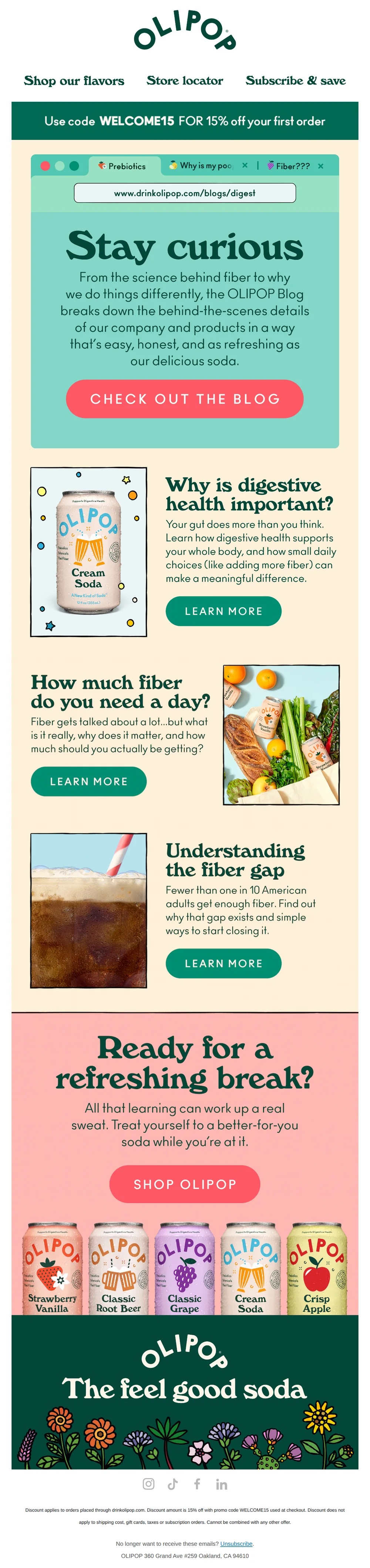
Want to Nerd Out With Us? 🥤📚
Pattern: browser tabs mock-up makes gut health feel relatable.
Use it here: Teach a real customer question in a playful format so the product is the natural next step, not a forced promo interruption.
Open reference in new tab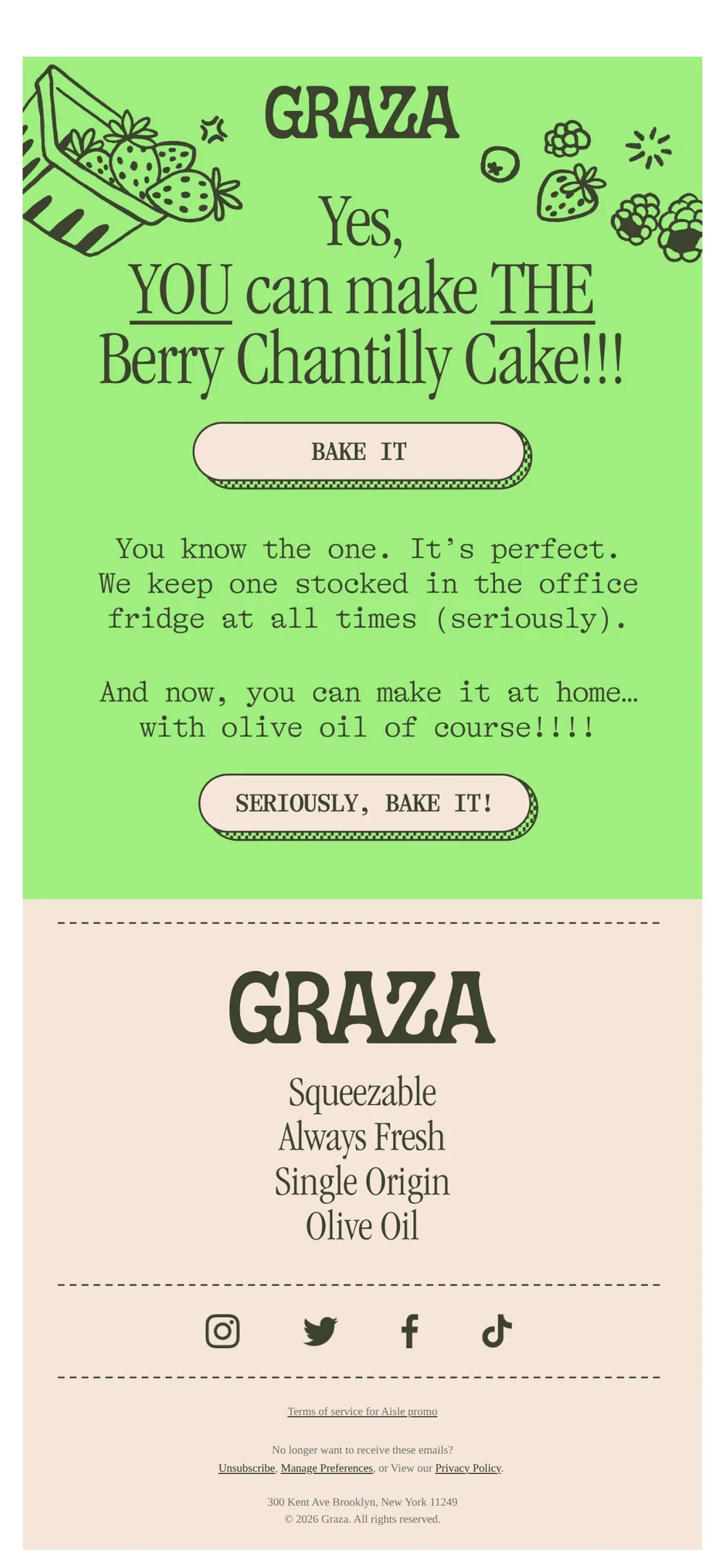
It’s Berry Chantilly Cake season 🍓🫐
Pattern: You can make the viral Berry Chantilly Cake at home.
Use it here: Useful recipe or use-case content can create a full-price reason to send when it connects directly to how the product is used.
Open reference in new tabCreative and design curation only. These are role references, not reported revenue, conversion, or a promise that the exact tactic will transfer unchanged.
Need help implementing this?
We build and manage complete email & SMS programs for DTC brands. Get a custom plan for your brand.
Get Your Free Audit + Gameplan