How to Run a Product Launch or Drop by Email
The best DTC brands treat every launch like an event. Here is the email and SMS sequence that builds anticipation and sells through a drop.
- Plan the campaign using the framework in this lesson
- QA the offer, audience, creative, and measurement plan
Why does a launch sequence beat a single announcement email?
Because a launch sequence gives the audience more than one legitimate reason to pay attention: anticipation, access, product context, and an actual closing condition. More sends do not automatically create more revenue. ZHS launch operating guidance is to plan only the messages that add a new, truthful reason to act, then set the cadence from inventory, waitlist size, customer frequency, and the real launch deadline.
Treat a launch like an event, not a single send. Build a waitlist early enough to give people a real reason to opt in, and use email and, where valid consent exists, SMS to communicate the access they actually receive. Plan a sequence around distinct jobs: teaser, optional early access, public launch, evidence-backed reminders, and a final message only when a real deadline exists. Keep urgency real, and use a calendar so the team can repeat what it learns without copying an arbitrary send count.
Some teams announce a new product once and have no planned way to build anticipation, explain the product, or honor access. A launch can be treated as an event when the product, inventory, and calendar warrant it: build awareness, communicate clearly while it is available, and close only with real urgency.
Here is what this looks like in practice.

How do you build a launch waitlist?
Start early enough for the waitlist to have a real purpose. Run a teaser pop-up that grows your list and a landing page that capture email, and SMS only with the appropriate separate consent, in exchange for clearly described early access. You are not selling yet; you are collecting people who explicitly asked to hear about the product. When the drop hits, that creates a qualified opt-in audience rather than a reason to blanket-message everyone.
The waitlist is not a revenue guarantee. It is a way to measure whether the promise, product, and access proposition are earning attention before the public release.
Use the actual launch runway to decide when a teaser pop-up and landing page should begin collecting email. Offer SMS only through a separate opt-in and only when it will receive a clearly described benefit. You are building a list of people who chose launch information, not claiming that every contact is ready to buy.
Drive signups from a teaser email and, for subscribers who have consented, an SMS campaign. Make the access benefit specific: what opens first, for whom, and under what conditions. Track signups, opt-in quality, and subsequent purchase behavior separately so the team can decide whether the waitlist is worth repeating.
Early access can be a clear reason to offer SMS, but it is not a reason to pressure someone into giving a number. Use a distinct, compliant opt-in, explain what messages they will receive, and make email-only access available where appropriate. A real waitlist can support honest launch communication; it does not prove a sellout outcome.
What goes in a product launch email sequence?
Build the sequence around the jobs the launch actually needs: build awareness, honor any earned access, open publicly, add useful proof or context, and close only when a real deadline or inventory condition exists. There is no universal send count or launch window. Treat the sequence below as a ZHS planning framework, then document the audience, channel consent, inventory, and measurement plan before setting dates.
Use this planning flow to give every message a job, then adapt or omit steps that do not fit the launch.
What goes in a product launch email sequence
- 01Before public launchTeaser and waitlist
Give a first look, a release condition, and a truthful reason to join the waitlist. Measure whether the audience responds before adding more messages.
- 02Optional early-access windowHonor the access promise
Let the eligible audience shop first only when the access and inventory conditions are real. State who qualifies and when the public release begins.
- 03Public launchIt is live
Use a clear headline, one primary CTA, and product context. Coordinate email and SMS only for audiences who have opted into each channel.
- 04While there is a new reason to sendUseful reminders
Follow up with a genuinely different angle: reviews, UGC, product education, or use case. Test text-forward and designed treatments; do not assume either format wins.
- 05Actual closing conditionClose honestly
Use low-stock, deadline, or last-chance language only when it can be verified. If the condition changes, update the message instead of extending a false final notice.
Structured from the canonical article steps for responsive reading and presenter mode.
What is the difference between the hype and sell-through phases?
The hype phase builds anticipation; the later phase helps qualified customers make a decision. Early on, tease only what you can stand behind, give a clear release condition, and invite waitlist signups. Later, add useful context or real scarcity, low stock, a stated cutoff, or a final production run, only when it is verifiable. A text-forward last-chance message is one treatment to test, not a guaranteed back-end winner.
The two ends of a launch do opposite jobs. Nail both.
- Tease, do not reveal everything
- Give a release condition and use a countdown only when it is real
- Invite waitlist and separately consented SMS signups
- Sell the story, not the discount
- Verified scarcity: accurate stock or a real cutoff
- Multiple reminders, fresh angles each time
- Test a text-forward final reminder when it adds a new reason to act
- Use VIP demand proof only when it is true and permissioned
The same shift shows up in your texts. Hype phase:
Only when true: Something new drops Thursday. Eligible waitlist members get access first: [link]
Sell-through phase:
Only when true: Limited stock remains and access closes tonight: [link]
The urgency at the end has to be real. Fake countdowns and recycled final notices can erode trust. If a limited drop is actually unavailable, say so accurately and use the resulting interest to inform a restock or waitlist decision, not as retroactive proof that every launch will behave the same way.
How do you make product drops recurring?
Put launches on a calendar and give the list a real reason to pay attention each time. Limited runs, new colors, restocks, bundles, and collaborations can each be a launch-worthy moment without requiring a discount. A recurring calendar makes the team plan inventory, creative, channel eligibility, and measurement in advance; it does not remove the need to validate demand for each release.
Limited runs, new colors, restocks, bundles, and collaborations can provide a legitimate reason to communicate when they are meaningful to the audience. A launch does not require a discount by default. A new variant, bundle, collaboration, or limited edition can be tested as a full-margin message; a restock can pair with a back-in-stock flow that notifies people who opted in for availability.
Only when true: Early access is live for eligible subscribers before public release: [link]
Run drops on a campaign calendar, not on impulse. That gives the team a repeatable planning and learning process, even when each launch produces a different commercial outcome.
What are the most common product launch mistakes?
Common launch mistakes include treating the release as a single announcement, skipping a purposeful waitlist, using false urgency, treating channels as interchangeable, and making the drop impossible to learn from. The remedy is not a fixed number of sends; it is a documented launch hypothesis, real claims, consent-aware channel use, and a post-launch review.
- One announcement, done. A single send gives the team little room to build anticipation or answer objections. Add messages only when each has a distinct, truthful job.
- No purposeful waitlist. You lose a chance to identify people who explicitly want launch information. Build the list early enough to honor a meaningful access promise.
- Treating a final reminder as mandatory. A closing message belongs only where there is a verifiable deadline, stock condition, or end of access, not because a template says it should exist.
- Fake urgency. Countdowns that reset and "last chance" emails that never end kill trust. Keep scarcity real.
- Treating email and SMS as interchangeable. Use each channel only for people who opted in, and coordinate the message without assuming every audience needs both.
- Treating it as a one-off. Capture what happened, signups, eligible audience, send exposure, conversion, inventory, and qualitative feedback, so the next launch starts with evidence rather than a copy-pasted calendar.
Get Expert Help
A well-run launch needs a clear sequence, an honest access proposition, and consent-aware channel coordination. Our team can build and run drop campaigns for DTC brands, then review the evidence after each launch rather than assuming a fixed sequence will fit every product.
More patterns to study
Curated creative references for this lesson. Study the mechanism, then adapt it to your own audience, offer, and evidence.

ready for take-off.
Pattern: travel-themed sexual wellness collection launch.
Use it here: A launch can borrow a full creative world when the product and audience genuinely support it; align the landing page, inventory, and access rules.
Open reference in new tab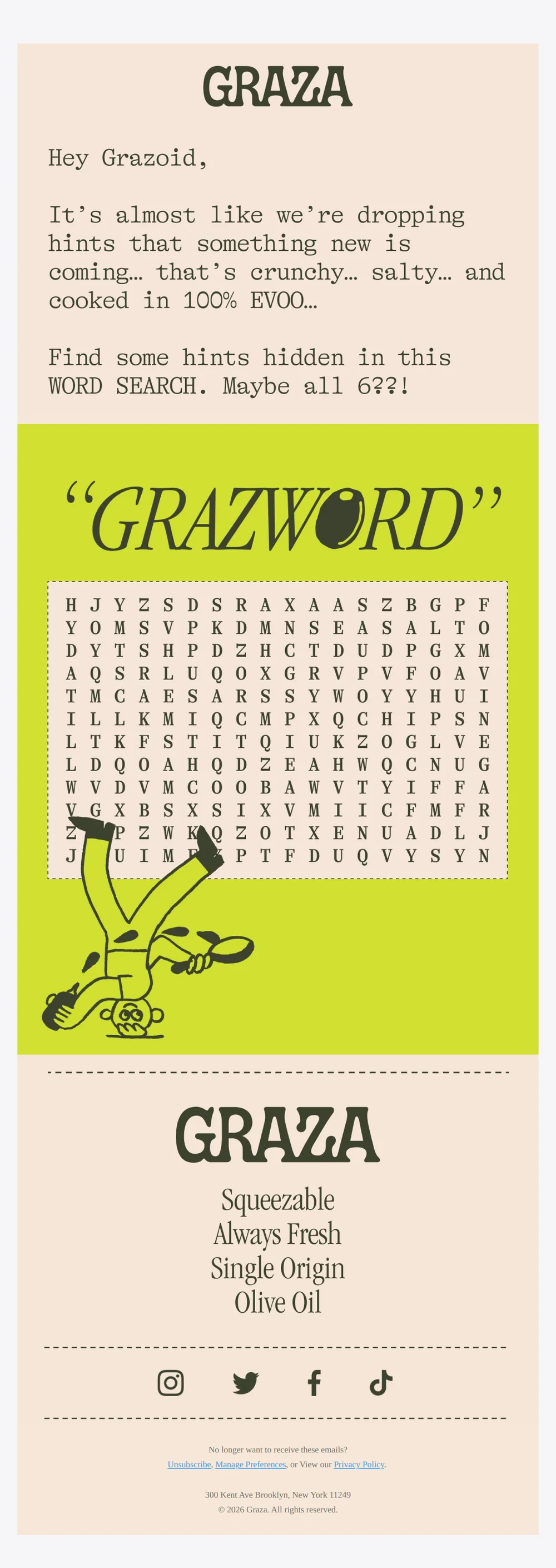
Something salty in the Grazaverse 👀
Pattern: word search teases crunchy new EVOO product launch.
Use it here: A teaser works when it creates a specific question that the later launch resolves, not when it hides basic product information without a reason.
Open reference in new tabCreative and design curation only. These are role references, not reported revenue, conversion, or a promise that the exact tactic will transfer unchanged.
Need help implementing this?
We build and manage complete email & SMS programs for DTC brands. Get a custom plan for your brand.
Get Your Free Audit + Gameplan