Email Lessons From Brands Doing It Right
How to study strong DTC email programs without copying surface-level tactics: extract the operating decision, test it in your context, and preserve your brand.
- Separate a case-study observation from a reusable operating decision
- Turn performance signals into an operating decision
Why should you study the brands doing email right?
Study strong brands to identify reusable decisions, offer framing, information hierarchy, cadence, proof, and audience treatment, not to copy their surface design. The useful question is what job each send performs and why that choice fits the brand and customer moment.
The ROI range above is broad industry context, not a promise for an individual brand. Likewise, a public brand archive or a ZHS client result is a case study: it can show a decision worth testing, but it cannot prove that the same decision will create the same result in a different catalog, traffic mix, or attribution model.
Do not copy a brand's send count, visual style, or promotion calendar as a universal prescription. Extract the decision underneath it: who the message was for, what it asked them to do, what proof it supplied, and what happened next. Then test that decision against your own margin, inventory, consent, audience quality, and reporting definition.
How did one email promo make $75,090 in 6 days?
A documented ZHS apparel-client promotion generated $75,090 in platform-attributed sales during its campaign window by treating the sale as a sequence rather than a one-off blast. It is a first-party case record, not a forecast: traffic, offer, inventory, sender reputation, attribution settings, and audience eligibility all affected the result.
The transferable lesson was the operating structure. The team launched when the offer was live, varied the reason to return across the window, removed purchasers from repeat promotional pressure unless a separate post-purchase message was intentional, and split the closeout by buyer status.
This is an internal ZHS case observation. Platform-attributed revenue is not incrementality, and the numbers should not be reused as a benchmark or revenue promise. Use the sequence below as a planning pattern, then measure your own eligible audience, conversion, unsubscribe trend, complaint trend, margin, and inventory outcome.
A promotion sequence worth adapting
- 01LaunchOpen with the clearest offer
Send to a deliberately eligible audience with one clear reason to act and a landing page that matches the promise.
- 02Mid-windowChange the reason to return
Use proof, product education, sizing help, or a different collection instead of repeating the launch message verbatim.
- 03CloseProtect the customer state
Suppress recent purchasers from repeat sale pressure unless the next message has a distinct post-purchase job.
- 04After the offerSplit buyers and non-buyers
Thank buyers; give non-buyers a useful next step only if margin, inventory, and pressure rules support it.
A ZHS case-derived planning pattern, not a required number of sends or a revenue forecast.
After someone purchases, another identical "ending soon" message rarely serves the same job. Suppress them from repeat promotional pressure by default, then deliberately decide whether they belong in a thank-you, cross-sell, replenishment, referral, or service message instead.
How often should you send marketing emails?
Send at a cadence your list can rely on and your team can sustain; there is no magic number that transfers across brands. Establish a baseline by engagement cohort and message type, then increase only when incremental sends continue to create worthwhile outcomes without worsening fatigue signals.
Two respected operators can use radically different frequencies because their audience expectation, content supply, purchase cycle, and sender reputation are different. The number is not the lesson. A consistent, useful program is.
Use the campaign cadence playbook to set a starting schedule. Review it by cohort instead of treating one headline cadence as a permanent rule.
Value does not mean avoiding a commercial message. It means every send earns its place: a product decision, useful proof, a timely update, an offer with a real reason, or a next step that helps the customer. If a send has no job beyond filling the calendar, it is a candidate to cut.
Should every email be designed or plain-text?
No. Use the format that makes the message easiest to understand and most native to your brand, then test it against a comparable audience and job. A public brand's highly designed archive or an operator's plain-text style is evidence of a deliberate creative system, not proof that the same format will win for you.
Olipop is useful to study for visual consistency and voice, while operator-led plain-text programs are useful to study for clarity and speed. Neither observation settles the format question for a premium product launch, a founder note, a replenishment reminder, or a support-sensitive message.
Start with the message job. Product education, merchandising, and brand storytelling often need visual hierarchy. A concise founder update or tactical recommendation may work better with a lighter format. Compare the same audience, offer, and send time before calling a winner; the plain-text email playbook covers that decision in more depth.
How do you sell a high-AOV product over email?
Match the email to the buyer's decision process. Higher-consideration purchases typically need more education, comparison help, proof, financing clarity where applicable, and reassurance about the next step, not simply a louder generic promotion.
In a ZHS luxury-client case, product-specific sequences replaced a generic abandonment treatment. The useful insight was not a claimed revenue multiplier; it was that each message answered a real purchase objection for the product the shopper had considered.
A high-consideration email path
- 01First touchSet the purchase frame
Explain the product category, the intended buyer, and the decision the product helps make.
- 02ConsiderationResolve the next objection
Use comparisons, proof, delivery expectations, financing context where applicable, or concierge help that fits the product.
- 03Return visitReconnect to the viewed product
Keep the message specific to the product and customer state rather than sending a generic catalog blast.
A case-derived sequence pattern for considered purchases; actual timing and content should follow the buying cycle.
The welcome flow built on positioning is often the first place to establish that decision frame. Treat a long consideration cycle as information about the purchase, not as a reason to force urgency that the product cannot support.
How much does email segmentation actually improve ROI?
Segmentation improves decision quality when it changes the message, offer, timing, or suppression rule in a way that matches customer intent. Do not use a single lift percentage from another operator as your expected ROI; validate the effect with your own cohort-level test and a consistent attribution definition.
Useful segmentation examples include product interest, purchase status, lifecycle stage, consent, geography, and engagement. The goal is not to create elaborate branches for their own sake. It is to avoid giving every subscriber the same message when you already know something material about their intent.
For example, a two-step capture flow can collect an email before requesting optional SMS consent, and a product-interest prompt can inform the welcome sequence. The exact incentive, field order, and audience treatment should protect consent, the promised offer, and the customer experience. Start with the email segmentation strategy when building the audience logic.
- Same message despite known product interest
- One promotion for buyers and non-buyers
- No adjustment for lifecycle or engagement
- Reporting cannot explain who the send helped
- Content matched to a meaningful customer signal
- Suppression and eligibility chosen deliberately
- Proof and education scaled to the purchase decision
- Outcome compared by audience and message job
The principles in one table
| Principle | What to inspect in the example | What to test in your program |
|---|---|---|
| Show up on a reliable schedule | Audience expectation, message jobs, and engagement by cohort | A sustainable cadence with a clear send purpose |
| Give value before the ask | Whether the message makes a useful decision easier | A useful proof, explanation, or timely update between promotions |
| Build brand in every send | Voice, hierarchy, visual system, and product context | A format that is recognizable and clear for that message job |
| Match the email to intent | Product viewed, buyer state, consideration friction, and eligibility | A product- or state-specific sequence where the signal justifies it |
| Segment deliberately | The data used and the message it changes | One meaningful branch with a measurable outcome |
| Run a promo as a sequence | Launch, mid-window, closeout, and post-purchase treatment | A campaign plan that avoids repeating the same pressure blindly |
What are the most common email marketing mistakes?
The recurring mistakes are treating case-study outcomes as universal benchmarks, copying a cadence without its audience context, and sending one message to everyone despite knowing their intent. Fix the operating decision before adding more volume or visual complexity.
- Emailing only when you want a sale. Give each message a customer-facing job, not just a calendar slot.
- Copying a cadence number blindly. Set a baseline for your audience and review it by cohort.
- Copying a format instead of a message job. Designed and plain-text formats both have a place when they are intentional.
- One message for the whole list. Use the signals you already have when they meaningfully change the message.
- Treating consideration as a failure. For complex purchases, education and proof may be the conversion work.
- Making unsubscribe hard. Let an unqualified subscriber leave rather than converting a mismatch into ongoing fatigue or a complaint.
- Repeating promotion to recent purchasers. Default to suppression, then choose a genuinely different post-purchase job if appropriate.
- Ending a sale cold. Plan buyer and non-buyer follow-up before launch; only extend or change the offer when it remains commercially and experientially sound.
Get Expert Help
These principles are simple to name and harder to run across a full calendar of designed campaigns, flows, segmentation, and SMS.
Our team builds intent-based, brand-consistent retention systems, then measures the decisions that matter instead of borrowing a result from somebody else's account.
More patterns to study
Curated creative references for this lesson. Study the mechanism, then adapt it to your own audience, offer, and evidence.
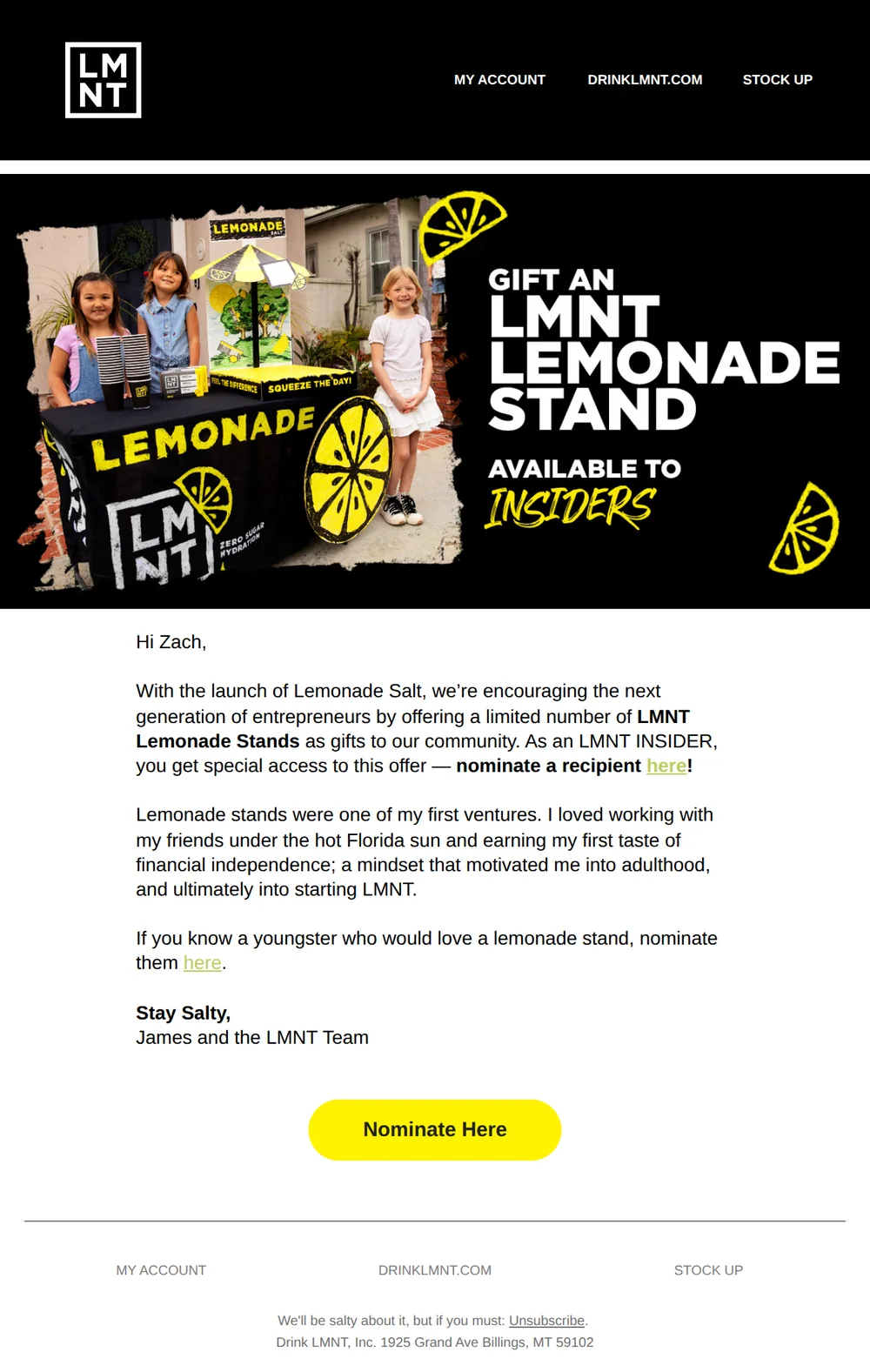
Nominate an LMNT Lemonade Stand Recipient
Pattern: Gift a real lemonade stand to a young entrepreneur.
Use it here: A brand can make a promotional mechanic memorable by giving it a community role that fits its own origin story and audience.
Open reference in new tab
NEW: Meet “Shhhhizzle” Keyboard Oil ⌨️
Pattern: Olive oil branded as 'keyboard oil' via Yahoo collab.
Use it here: A surprising angle works when it is native to the brand voice; the lesson is coherence, not copying the joke or visual gag.
Open reference in new tab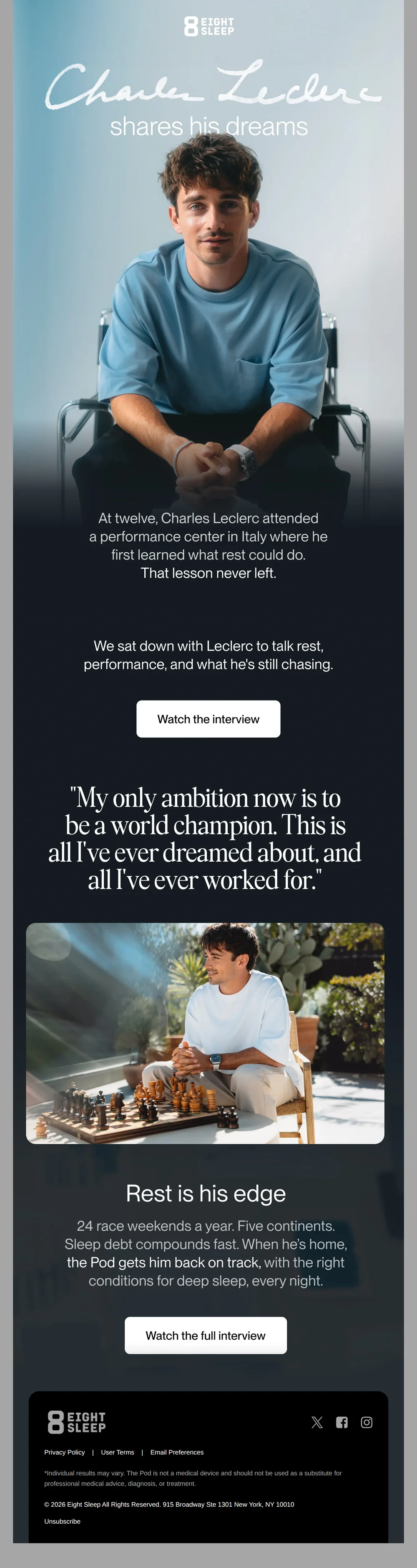
What does Charles Leclerc dream about?
Pattern: F1 champion reveals how sleep drives peak performance.
Use it here: Use social proof as a story with a relevant outcome, not as a disconnected celebrity logo or generic testimonial strip.
Open reference in new tabCreative and design curation only. These are role references, not reported revenue, conversion, or a promise that the exact tactic will transfer unchanged.
Need help implementing this?
We build and manage complete email & SMS programs for DTC brands. Get a custom plan for your brand.
Get Your Free Audit + Gameplan