How Often Should You Send? The Campaign Cadence Playbook
Build a measurable email campaign cadence around recipient pressure, engagement tracks, commercial moments, and marginal performance, not a universal send-count rule.
- Plan the campaign using the framework in this lesson
- QA the offer, audience, creative, and measurement plan
No prior lesson required.
How many email campaigns should you send per month?
Choose cadence from the recipient level, not a universal monthly quota. The ZHS starting hypothesis for a mature program is often a fuller calendar, commonly around 12 to 16 total planned sends, but it is a house operating range, not an industry benchmark or revenue promise. Engagement, inventory, offer calendar, consent, production capacity, and negative signals decide whether it fits.
Plan enough useful contact to learn, but do not make every subscriber receive every send. Split the audience into engagement tracks, give each message a clear job, and increase only one track at a time when marginal contribution remains healthy and the canonical click and unsubscribe guardrails hold.
An under-operated account often clusters communication around promotions. That can leave the team with little editorial learning, weak product education, and an audience trained to hear from the brand only when there is a discount. The correction is an intentional calendar with useful non-promotional messages, not indiscriminate volume.
Want the walkthrough on camera? Here is what this looks like in practice.
How does send frequency affect email revenue?
Cadence creates more opportunities, but send count alone does not cause a particular revenue share. Compare marginal performance by engagement track. Increase frequency where another send still contributes efficient conversion and total attributed revenue; reduce it where complaints, unsubscribes, or weak marginal return show fatigue.
Treat cadence as a controlled ladder, not a revenue-share lookup table.
How to increase campaign cadence responsibly
- 01BaselineMeasure each engagement track
Record delivered volume, click, conversion, total attributed revenue, unsubscribe, complaints, and production cost.
- 02Add oneIncrease one track at a time
Add a useful send to the audience with the clearest demand; do not raise every segment simultaneously.
- 03CompareJudge marginal performance
Compare the added send and the full track against the same definitions and a comparable period.
- 04Keep or reverseLet guardrails decide
Keep frequency when contribution remains efficient and negative signals stay healthy; reverse it when marginal value disappears.
ZHS often operates mature calendars at 12-16 campaigns per month, but the recipient-level pressure and marginal result decide whether that cadence fits.
There is no responsible maximum that fits every recipient, list, or inbox provider. Treat one added send to one engagement track as a controlled change, then compare it with that track's prior performance.
As you scale, calculate contribution after production cost rather than relying on a universal ROAS promise. Include team time, creative, tools, discounts, COGS, refunds, and channel cost. Add frequency only when the marginal send supports the business case.
Use this decision rule instead of a revenue-per-send ladder:
- Sparse or noisy history. Stabilize the calendar, improve the core message jobs, and establish comparable cohorts before increasing volume.
- Healthy marginal contribution. Add a useful send to one eligible track, then compare its incremental result with the prior calendar.
- Fatigue or weak marginal return. Reduce pressure for that track, tighten eligibility, or replace the message job before raising volume again.
Will sending more emails burn out my list?
Frequency becomes a problem when it outruns audience attention, message variety, and consent, not at one universal send count. Watch unsubscribe, complaint, click, and revenue-per-recipient trends by audience while increasing volume in controlled steps.
It can, especially when the same recipients repeatedly receive weak, irrelevant, or poorly timed messages. Segmentation helps, but it is not a permission slip to send more. Give more priority to recently engaged audiences and reduce pressure for people who have gone quiet; use engagement-based segmentation to define that logic.
The fix is not simply sending less or more. It is making each audience's next message more relevant, then watching the results by track.
- One audience receives the same calendar
- Promotions carry most of the communication
- Cadence changes without a measured hypothesis
- Negative signals are reviewed only in aggregate
- Each audience has an eligibility rule and message job
- Commercial and editorial messages are planned together
- Marginal contribution and negative signals are documented
- Cadence changes are reversible and measured
Use a competitor's visible cadence as creative research, not as a deliverability or revenue benchmark. Their list composition, sender reputation, offer calendar, and audience relationship may be very different from yours.
List fatigue is real. Diagnose it through trend and cohort analysis, then adjust eligibility, message mix, and frequency together instead of guessing from your own inbox tolerance.
How do you split an email list into engagement tracks?
Start with a small set of operational tracks based on actual engagement and purchase signals. The labels can be high intent, warm, and inactive or lapsed; the exact time windows must reflect your sales cycle, consent state, and mail-provider signals.
| Track | Eligibility principle | Cadence principle |
|---|---|---|
| High intent | Recent meaningful engagement or purchase activity | Eligible for the most relevant launches, education, and commercial messages |
| Warm | Some recent signal, but less consistent activity | Receive the core calendar with less pressure than high intent |
| Inactive or lapsed | Little recent engagement, or a dedicated reactivation state | Protect sender reputation; use a defined reactivation or suppression policy |
When a metric deteriorates, do not cut volume across the entire account. Inspect the affected track, tighten eligibility if needed, and test a more useful message before changing the whole calendar.
How do you build an email campaign calendar?
Start with the commercial moments that are real, launches, inventory events, shipping deadlines, and approved offers, then backfill the calendar with education, product story, proof, and service messages. A calendar should create purposeful repetition and clean learning, not a fixed content ratio.
Founders often plan paid media well ahead and improvise email. That creates production gaps, repetitive offers, and weak learning because the channel has no deliberate operating rhythm.
Use this illustrative board as a planning prompt. It is not a mandatory weekly send count:
| Week | Send 1 | Send 2 | Send 3 |
|---|---|---|---|
| Week 1 | Education / value | Product story | Promo launch |
| Week 2 | Social proof (UGC) | Promo reminder | New arrival |
| Week 3 | How-to / value | Customer story | Bundle or restock |
| Week 4 | Behind the scenes | Bestseller spotlight | Month-end offer |
Mix plain-text emails and designed messages when the job, creative, and audience call for them. Test format and send timing within your own program; neither a particular day nor a particular format mix is universally best.
Review the board before production: every send should have a target audience, a message job, an offer or non-offer decision, a destination, a QA owner, and a measurement plan.
A ZHS example: the 16-campaign month
The following is an illustrative ZHS planning board for a mature brand with enough demand, production capacity, and engaged audience coverage. It is not a promise that every brand should run the same volume or achieve a particular revenue result.
- Promotional messages. Schedule genuine launches, drops, and deadline moments, with re-sends only where eligibility and the original result justify them.
- Evergreen or nurture messages. Use content, storytelling, product usage, and social proof to make the calendar useful between promotions.
- Format mix. Choose plain text or designed creative based on the message job and test history.
- SMS moments. Add only where the subscriber has the appropriate consent, the message is distinct from email, and the operating policy supports it. For message design, see SMS campaigns that convert.
No single subscriber gets every planned send. Total calendar volume is distributed through the eligibility rules above.
What the calendar actually tracks. Our campaign calendars live in a spreadsheet, one per brand, with a row for every send. For each one we lock the target date, the send time, whether it is email or SMS, and the campaign type: evergreen, promo, or nurture. Then the name, the description, the primary and secondary focus, the segments we include AND the ones we exclude, any offer or discount code, the split test, the SKUs we are pushing, and the CTA or landing page.
Run only the tests your team can interpret and act on. Report on a regular cadence, watch total recipient pressure, and roll the prior period's learning into the next calendar.
What are the most common email cadence mistakes?
The big one is treating cadence as a universal number rather than a measured operating decision. Build a calendar around meaningful customer moments, then let comparable data set the pace.
- One audience receives every campaign. Split into engagement tracks so eligibility changes with customer state.
- Every message is a discount. Give the calendar education, product story, proof, service, and community jobs too.
- The calendar is improvised. Lock real commercial moments first, then backfill with messages that support the customer journey.
- Personal inbox tolerance becomes the rule. Let recipient-level trends and evidence decide instead.
- Inactive audiences receive the same pressure as active buyers. Define a reactivation or suppression policy.
- A resend is automatic. Re-send only after checking eligibility, fatigue risk, and whether the original message warranted another attempt.
How do you calculate revenue per email send?
Multiply three numbers: eligible recipients reached, your own comparable campaign place-order rate, and net average order value. That produces a directional attributed-revenue estimate. Compare it with the fully loaded cost per send and contribution margin, not a universal DTC conversion rate.
Before you decide on volume, figure out what a single send is actually worth. It is simple arithmetic.
- Subscribers per send. How many people you actually reach on an average campaign.
- Place-order rate. Use the median from comparable sends to the same audience and campaign type. If history is sparse, model a low/base/high range and label it as an assumption.
- Average order value. Your real AOV.
Multiply those inputs to estimate attributed campaign revenue, then compare the result with production cost and contribution margin. Scale only after several comparable sends show stable economics and acceptable unsubscribe, complaint, and deliverability trends.
What are good email campaign benchmarks?
Use click and unsubscribe bands as diagnostic guardrails, then judge placed-order rate and total attributed revenue against comparable sends from your own program. Benchmark definitions must match the audience, denominator, period, and attribution settings before comparison.
Use the canonical cards as diagnostics, not as a standalone cadence target. Compare placed-order rate and total attributed revenue with comparable sends from your own program; definitions must match the audience, denominator, period, and attribution settings. Open rate is a secondary trend because Apple Mail Privacy Protection can inflate it. For the combined attributed revenue-share framework, use the canonical email and SMS benchmark guide.
Get Expert Help
Our team maps a full month of campaigns, splits the list by reliable engagement, and adjusts cadence from marginal performance rather than chasing a universal revenue-share promise.
We handle the calendar, the tracks, and the send-time details so you stop guessing and start compounding.
More patterns to study
Curated creative references for this lesson. Study the mechanism, then adapt it to your own audience, offer, and evidence.
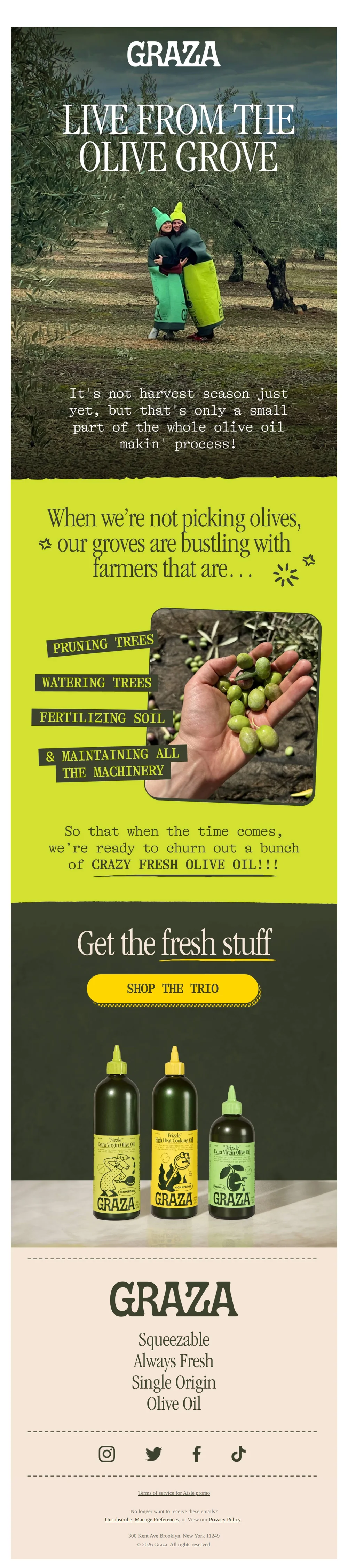
Live from The Olive Grove 🫒
Pattern: behind-the-scenes farm life builds brand authenticity.
Use it here: A behind-the-scenes education send earns its place in a calendar when it gives the list a fresh reason to care beyond the next promotion.
Open reference in new tab
Feeling poetic? You could win a FREE prize ✨
Pattern: pairing non-alc drinks with original poetry.
Use it here: Editorial storytelling can support a recurring program when the topic is genuinely useful to the audience, not merely a change of visual wrapper.
Open reference in new tabCreative and design curation only. These are role references, not reported revenue, conversion, or a promise that the exact tactic will transfer unchanged.
Need help implementing this?
We build and manage complete email & SMS programs for DTC brands. Get a custom plan for your brand.
Get Your Free Audit + Gameplan