Alex Hormozi's Email Marketing Strategy, Applied to DTC Brands
A DTC-ready reading of Alex Hormozi's give-give-give-ask approach: use the operating ideas without treating creator-reported results as a universal benchmark or revenue promise.
- Choose the right retention metric and denominator
- Turn performance signals into an operating decision
What is Alex Hormozi's email marketing strategy?
Hormozi's public email stories emphasize a useful operating posture: give people useful content, make the next action clear, segment deliberately, and test a conversion event before a broad rollout. Treat the reported results in a creator case study as context for the story, not as an independently verified benchmark or a DTC revenue forecast.
In his public discussions, Hormozi describes underinvesting in email and later treating it as a major owned-content channel.
That framing is useful, but it is not a substitute for a measurement plan: revenue attribution, margin, incrementality, deliverability, and customer experience all matter.
The article translates the durable parts of that philosophy to a DTC brand running Klaviyo, while separating individual claims from the broader industry context.
Use a give-heavy calendar, clear segmentation, and a controlled conversion test when they fit the business. A creator's reported campaign outcome is a case study, not a promise that the same cadence, offer, or list treatment will produce the same result for another brand.
What is the give-give-give-ask ratio in email?
Use a give-heavy mix rather than treating a fixed ratio as a law. The right balance depends on purchase cycle, audience expectation, promotion calendar, and whether the non-promotional messages are genuinely useful.
Hormozi's mental model is that an offer can consume attention, so useful messages should earn the next ask. That is a strategic lens, not a measurable law of goodwill.
For a DTC calendar, define the job of every send before you schedule it: teach, help someone choose, show proof, announce, or convert. If a message does none of those, it probably does not deserve another interruption.
The practical translation is not "never promote." It is to make the promotion legible and to keep the surrounding content worth opening.
Weight the calendar toward value when the promotion calendar allows it: product education, use cases, a founder story, a customer result, styling guidance, or care guidance. Compare the mix with click, unsubscribe, complaint, and conversion trends rather than assuming a numeric ratio will fit every list.
This is the same weighting we lay out in the campaign calendar, and the copy craft behind each give is in email copywriting fundamentals.
Use a hook that the body can honestly repay, a focused idea, and a clear next action. A P.S. can be useful when it adds context or a secondary action, but it should not rescue an unfocused email.
How often should you send marketing emails, according to Hormozi?
There is no transferable Hormozi send cadence for a DTC list. Start from a cadence your team can sustain with relevant content, then test changes by eligible cohort while watching conversion, unsubscribe, complaint, and deliverability trends.
More messages can create more conversion opportunities, but they can also create fatigue. Quality, audience fit, and purchase cycle determine which effect wins.
Set a hypothesis before changing frequency: which audience is receiving which kind of extra message, why it is relevant, and what signal would make you stop or expand. This avoids mistaking sheer volume for a strategy.
Build an editorial system that makes useful content easier to produce, then hold it to the same quality bar as a product page or campaign launch.
If your program has been inconsistent, stabilize the minimum viable cadence before attempting an aggressive calendar.
For a DTC brand, choose cadence from actual launches, merchandising moments, customer need, and the ability to make each send distinct. Consistency can make planning easier, but mailbox placement is determined by a broader set of sender and recipient signals, not cadence alone.
What can a DTC brand learn from Hormozi's reported challenge case study?
Treat Hormozi's reported challenge result as a creator-attributed case study, not an independently verified benchmark. The useful transferable pattern is a narrow problem, a clear outcome, a controlled audience test, and an offer that can be measured without assuming a result will repeat.
The original business context, list quality, product economics, attribution, and upsell structure are not the same as a typical DTC store. A brand should not label inactive contacts as "dead" or use a reported revenue total to justify a broad send.
Here is the reusable campaign logic.
A controlled conversion-event framework
- 01Offer designSolve one narrow problem
Create a focused, useful experience drawn from a real customer need, with a clear outcome and an honest deadline.
- 02Audience testStart with an eligible cohort
Use a defined, consented audience and decide in advance what response would justify expansion or a pause.
- 03MeasurementEvaluate the whole outcome
Review conversion, margin, unsubscribe and complaint trends, support impact, and the quality of the resulting customers before broadening.
A reusable ZHS test framework, not a reproduction of a creator's reported revenue outcome.
A challenge can be useful when it produces a genuine small win and improves product understanding. It does not compress every customer's trust-building process, and it should never rely on misleading urgency or an unsupported performance claim.
How does a DTC brand run the Hormozi campaign in Klaviyo?
Use a conversion event when you have a relevant customer problem, a clear offer, and enough measurement discipline to learn from it. Do not make a fixed quarterly cleanup or a fixed test percentage the default; cadence and audience size should follow the product, list health, and prior response.
The practical goal is to re-engage eligible people with something genuinely useful, not to squeeze every non-buyer through the same promotion.
Here is how that maps to a DTC brand on Klaviyo.
- Pick the offer. Build a useful experience around a real customer need. A skincare brand might teach a routine; a cookware brand might offer a recipe sequence. Make the outcome, eligibility, and deadline clear.
- Build the segment. Target profiles whose consent and recent engagement make the message appropriate. Separate non-buyers, lapsed customers, and recent purchasers when their needs differ.
- Test a defined cohort. Decide the audience, success criteria, stop condition, and expansion rule before the first send. A weak result should lead to diagnosis, not a larger blast.
- Test one decision at a time. Subject line, opening, CTA, landing page, and offer framing can all be tested, but changing everything at once will not teach you what worked.
- Roll out or retire. Expand only if the result supports it; otherwise document the learning and replace the concept rather than disguising the same message with a new name.
Seasonal framing can make a genuine need timely, but a new wrapper does not turn an exhausted or irrelevant offer into a good one.
Between conversion events, return to useful content and lifecycle messages that support the relationship rather than training the audience to expect another deadline.
Prior acquisition spend does not make a future conversion cost-free. Include margin, fulfillment, incentives, creative, platform fees, support impact, and opportunity cost when you judge the campaign. The value of a retained audience comes from responsible, measurable follow-up.
What makes Hormozi's subject lines and hooks work?
The transferable lesson is not a magic statistic or a promised lift. A subject earns attention only when the opening and body honestly repay it, and preview text should make the context clearer rather than repeat the subject.
Think of email as a reward loop: a person opens because earlier messages were useful, so the next message needs to deliver quickly on the expectation it set.
Lead with a specific proof point only when it is true, attributable, and meaningful to the reader. Otherwise use a concrete observation, question, or customer problem that the body can answer.
Three practices a DTC brand can adapt:
- Lead with specificity or a real curiosity gap. Avoid vague promises and unsupported numbers.
- Write the preview text on purpose. Use it to clarify the value of opening, not as a duplicate or accidental first line.
- Test the subject with a valid decision rule. Define the audience, sample, success metric, and next action before treating a variant as the winner.
One more of his hook lessons, straight from the testimonial email. When you gather reviews, do not ask "how was life before us." Ask for the worst moment. The moment is what makes a hook, and the specific detail is what makes it hit. That applies to every customer story you put in an email.
The full craft of hooks, bodies, and CTAs is in email copywriting fundamentals.
What is the mindset shift Hormozi wants email marketers to make?
Stop treating every email as a promotion and start treating the channel as a reusable content and relationship system. You can control the content and your first-party audience relationship, but mailbox providers still control delivery and the program still has real costs.
This is the shift that reframes everything else.
Email is one-to-many content with a direct permission relationship. That makes relevance and respect for attention more important, not less.
Two things follow from that.
Make unsubscribing easy. Clear opt-out controls and appropriate suppression protect the customer experience and help the team manage a more meaningful audience. Review why emails land in spam for the broader deliverability factors instead of reducing placement to opens alone.
Make every email feel intentional. Plain-text and designed email can both work. Choose the format that communicates the job clearly, stays on brand, and is appropriate for the recipient; neither format guarantees a particular inbox tab. We break down the tradeoffs in email lessons from brands doing it right.
The through line is respect for attention. Make each send worth opening, starting with a welcome flow that earns the relationship before it asks for a sale.
The Hormozi playbook in one table
| Creator-inspired principle | Responsible DTC adaptation | Guardrail |
|---|---|---|
| Email is owned content | Treat sends as reusable content, not just promos | Delivery, margin, and incrementality still require measurement |
| Give before the ask | Use a value-heavy calendar where it fits the audience | Do not force a fixed give-to-promo ratio |
| Build cadence deliberately | Increase only when the audience and message justify it | Monitor response and fatigue by cohort |
| Segment by relevance | Use intent, consent, and purchase context | Do not assume every profile is eligible for every message |
| Test a conversion event | Start with a defined customer problem and success rule | A creator case study is not a revenue forecast |
| Make hooks honest | Write preview text and test a specific hypothesis | Do not use unsupported numbers as click bait |
| Make unsubscribing easy | Respect opt-out and suppression decisions | Do not equate a large list with a healthy list |
Get Expert Help
The creator-inspired moves are simple to name and harder to run across a full calendar of campaigns, flows, segments, and controlled conversion tests.
Our team builds the give-heavy calendar, segmentation, and conversion-test plan for DTC brands inside Klaviyo, with the measurement and audience rules needed to learn from each send.
Here is where to start.
More patterns to study
Curated creative references for this lesson. Study the mechanism, then adapt it to your own audience, offer, and evidence.
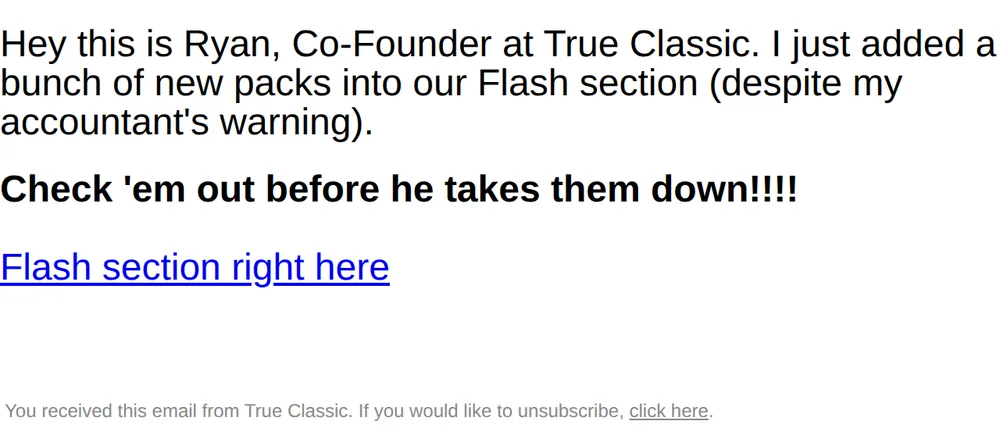
Please don’t tell my finance team
Pattern: Founder added deals despite accountant's warning.
Use it here: A distinct sender voice can make a direct offer feel human; use a real voice and a real constraint rather than role-playing urgency.
Open reference in new tab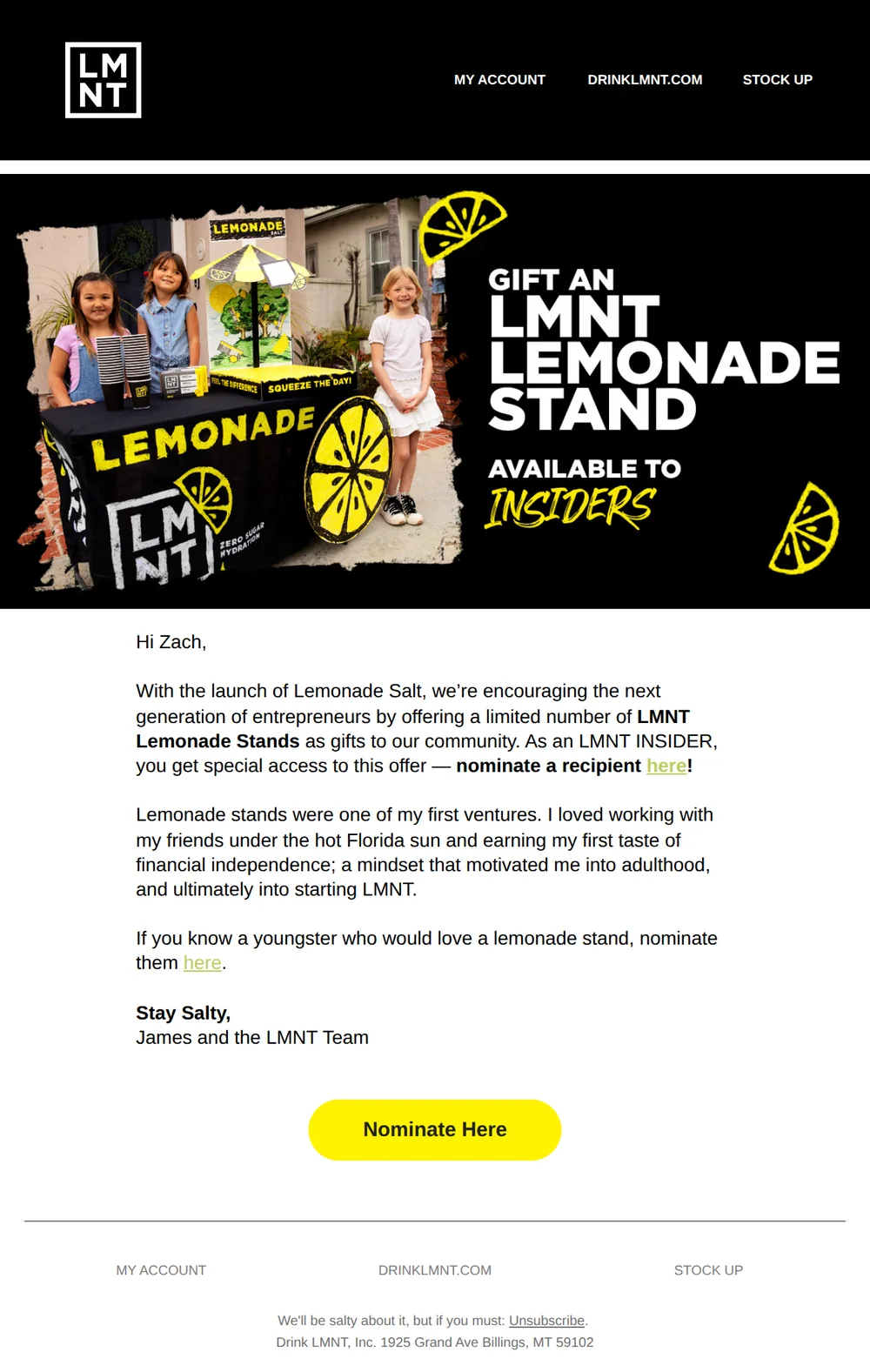
Nominate an LMNT Lemonade Stand Recipient
Pattern: Gift a real lemonade stand to a young entrepreneur.
Use it here: Value-first ideas earn attention when they are native to the audience and brand; convert that attention with a clear, relevant next action.
Open reference in new tabCreative and design curation only. These are role references, not reported revenue, conversion, or a promise that the exact tactic will transfer unchanged.
Need help implementing this?
We build and manage complete email & SMS programs for DTC brands. Get a custom plan for your brand.
Get Your Free Audit + Gameplan