How to Write Emails People Actually Read
Most brand emails get skimmed and deleted. Learn the ZHS approach to email copy: one idea per send, a hook that earns the open, and a CTA that gets the click.
- Write the message using the framework in this lesson
- Evaluate the copy against one clear customer action
No prior lesson required.
Why does email copy matter more than design?
Copy matters because it makes the message legible, relevant, and easy to act on. ZHS starts with one customer idea, a scannable structure, and a clear next action; design should reinforce that message rather than compensate for an unclear one.
In a crowded inbox, a reader should be able to understand why the email is relevant before they have to work for it.
Write with a recognizable human voice, keep the message focused, and make the next step clear. Those are production choices to test against the audience and the objective, not universal promises about open or revenue lift.
The approach is platform-agnostic: the email still needs a clear audience, honest claim, and measurable action.
Lead with the reader's result, not your announcement. Keep the message focused, write in a recognizable human voice, and make the primary action easy to find. ZHS treats these as copy-production standards; test the resulting message against the audience, offer, and campaign objective instead of attributing program performance to copy alone.
Here is what this looks like in practice.
How many ideas should one email have?
Start with one focal idea: a product, story, offer, or action. When two unrelated goals compete, the reader has to decide what the email is for; split the message when each goal needs its own context or proof.
Avoid combining a promotion, multiple product pitches, and a newsletter update in the same send unless a clear editorial structure connects them.
Pick the focal idea before writing the body.
Everything in the email should push that single thing. If a sentence does not move the reader toward that one action, cut it.
If you cannot explain the email's job in a sentence, separate the ideas or give one of them a supporting role. Your campaign cadence can hold a second, clearer send.
What makes a good email hook?
The opening line should earn attention for the next line. Skip generic greetings and lead with something the reader can recognize: a specific claim, a problem they feel, or an outcome they want. Put the mechanism and proof where they support that promise.
Your subject line earns the open. Your first line earns the read.
Generic greetings rarely create a reason to continue. Give the reader a concrete reason to care instead.
Open with the thing they care about: a specific claim, a problem they feel, or a result they want.
- "We're excited to announce our new collection is finally here."
- Leads with you, not them
- No reason to keep reading
- Every brand sounds like this
- "Greens that stay crisp all week. Meal prep that tastes as good Friday as it did Monday."
- Leads with the outcome
- Specific and easy to picture
- Pulls you into the next line
Lead with the result your product creates. Save the how-it-works for lower down.
Lead with the outcome, then earn belief with the mechanism, proof, or product detail.
Should email copy sound like a person or a brand?
Use a human, recognizable version of the brand voice, not generic corporate phrasing. Plain-language copy can be a strong variant to test, especially when the job is a founder note, a follow-up, or a service message, but it is not a universal replacement for designed or brand-led creative.
A plain text email can break the visual pattern and make a specific message feel more direct. Test it against a comparable designed control when the format choice matters.
Human tone is useful when it makes the message clearer and more credible. It does not guarantee a lift; measure the outcome that matches the send's job, not just opens.
You do not need a designer to write like a human. Use plain words, contractions where they fit, and the language a real person at the brand would use to explain the offer.
AI can accelerate a first draft, but it cannot verify product claims, decide what the audience already knows, or protect a distinctive brand voice on its own. Use it for options, then edit for accuracy, specificity, cadence, and the human point of view described in using AI to design emails.
The draft quality depends on the inputs. Give the tool approved brand language, product facts, customer research, and prior examples; then require a human review for factual accuracy, voice, offer terms, and links before the email is built.
- "We are pleased to offer our valued customers exclusive savings."
- "Utilize" instead of "use"
- Zero personality
- "Quick one: your size is back, and I didn't want you to miss it."
- Plain words, real voice
- Reads like a text from a friend
Here is what this looks like in practice.

What goes in the first fold of an email?
Put the identity, promise, supporting visual or proof, and primary action where a mobile reader can understand them without a long scroll. The first screen should make the next step obvious; the exact order depends on the audience, offer, and template.
The first fold is what people see before they scroll. It should establish relevance and make the primary action easy to find.
Use these elements as a production checklist, not an untested formula:
- Brand identity. Make it clear who is speaking.
- Headline. State the promise in a line a reader can scan.
- Offer or reason to act. If there is a code, make the redemption path obvious and test any auto-apply link in the storefront.
- Supporting image or proof. Use a visual only when it improves comprehension or desire.
- Primary CTA. Put the action where it is easy to find, then repeat the same action lower in a longer email if that helps the reader.
Do not let the main action disappear behind a long creative treatment. Review the mobile render and test the hierarchy when the placement of the CTA could change the result.
Get the button up top and repeat it lower if the email runs long.
How long should a marketing email be?
Match the length to the job. A simple offer may need only a short, scannable message; education, objections, or a complex product can need more context. The reader should be able to identify the promise and action without working through an unstructured wall of text.
Many readers scan quickly on small screens. Make that scan easy with short blocks, descriptive headings, intentional emphasis, and a clear action.
Keep the focal message and primary CTA clear. If a second idea needs its own proof or audience, split it into a separate email.
Break up dense copy. Use line breaks and headings to make the logic visible rather than forcing the reader through an essay-shaped block.
A reader should get the point even if they only catch the bold words and the CTA.
There is no universal paragraph count or sending frequency that wins. Use the shortest form that can make the honest case, then test a longer educational version only when the reader needs more information to act.
- A wall of text on a phone screen
- The point is buried mid-essay
- Reader scrolls, skims, gives up
- Primary action is difficult to find
- Short blocks with visible hierarchy
- Point lands on the bold words and the CTA alone
- Survives a fast scan on a phone
- Length matches the reader's decision
ZHS production standard: review the mobile render first, use comfortably tappable controls, and give the message enough space to breathe. Your own device and audience data should determine the exact layout and length; there is no universal scroll-depth rule.
When words get heavy, use a chart, icon, comparison, or simple sequence only when it makes the claim easier to understand. The visual should support an honest message, not substitute for one.
Should email copy be clever or clear?
Clear, always. A clever line you have to reread is a line that lost the sale, so say the thing plainly. "This restock is the final run, and it is gone for good after this" beats a pun nobody decodes. Clarity is what converts. Clever is a bonus only when it is also clear.
A clever line you have to reread is a line that lost the sale. Cute wordplay feels smart to write and confusing to receive.
Say the thing. "This restock is the final run, and it is gone for good after this" beats a pun nobody decodes.
Clarity is what converts. Clever is a bonus only when it is also clear.
Read your draft once, fast, the way a distracted person would. If you have to slow down to understand any line, rewrite it plain.
How many CTAs should an email have?
One. Decide the single action before you write a word, whether that is buy, click, reply, or read, then write every line toward it. Multiple competing buttons split attention and drop clicks. Use one clear CTA, repeat it lower if the email runs long, and cut the footer links that pull clicks away.
Decide what you want the reader to do before you write a word. Every send has one job: buy, click, reply, or read. Pick it, then write toward it.
Then give them one clear CTA and offer. Multiple competing buttons split attention and drop clicks.
When the copy points to a single action, the reader knows exactly what to do next. Here is what this looks like in practice.
How many CTAs should an email have
- 01Before you writeName the one action
Buy, click, reply, or read. Write it at the top of the doc so every line serves it.
- 02While you writeMatch copy to the goal
A sale email drives urgency. A post-purchase email teaches. Do not sell in an email built to help.
- 03Before you sendCut every other link
One CTA, repeated if the email is long. Kill the footer maze that pulls clicks away from the goal.
Structured from the canonical article steps for responsive reading and presenter mode.
Small Tactics That Add Up
A few things we do on every send that most brands skip.
Offer optional category routes deliberately. A small set of footer links can help a reader who is not interested in the main offer, but every additional link competes with the primary action. Add them only when the email's job and your click data support the tradeoff.
Always set a merge tag default. Use first name, and when it is missing fall back to something with personality. "Hey there," "hey you," "hey friend." Never ship an email that opens with a blank space where a name should be.
Make the voice distinctive when it fits. Specific, playful language can make a message memorable, but only if it is on-brand, understandable, and appropriate for the customer and offer.
Use real urgency, not fake urgency. State a deadline, inventory constraint, or offer condition only when it is true and will be honored. Sequence reminders around the actual endpoint, then target follow-up based on the reader's observed engagement and consent.
What are the most common email copy mistakes?
The recurring mistakes are mixing unrelated ideas, leading with the brand instead of the reader, using generic corporate language, hiding the logic in a wall of text, favoring cleverness over clarity, competing CTAs, and burying the primary action. Fix them by clarifying the job of the email and checking the final mobile render.
- Two ideas in one email. Split unrelated messages so each has a clear job.
- Opening with "we." Lead with the reader and the result they want, not your announcement.
- Writing in brand voice. Drop the corporate tone and write like a person texting a friend.
- Walls of text. Break up the message so the logic survives a fast scan.
- Clever over clear. If a line needs a reread, it lost the sale. Say it plain.
- Stacking CTAs. One action per email. Competing links split attention and drop your clicks.
- Burying the button. Make the main CTA easy to find in the mobile render and repeat it lower when the message warrants it.
Get Expert Help
Our team writes and tests email copy for DTC brands, then connects the creative review to the actual audience, offer, and campaign result.
If you want help applying this process, we can audit the current copy system, identify the highest-leverage tests, and build a clearer operating standard with your team.
More patterns to study
Curated creative references for this lesson. Study the mechanism, then adapt it to your own audience, offer, and evidence.
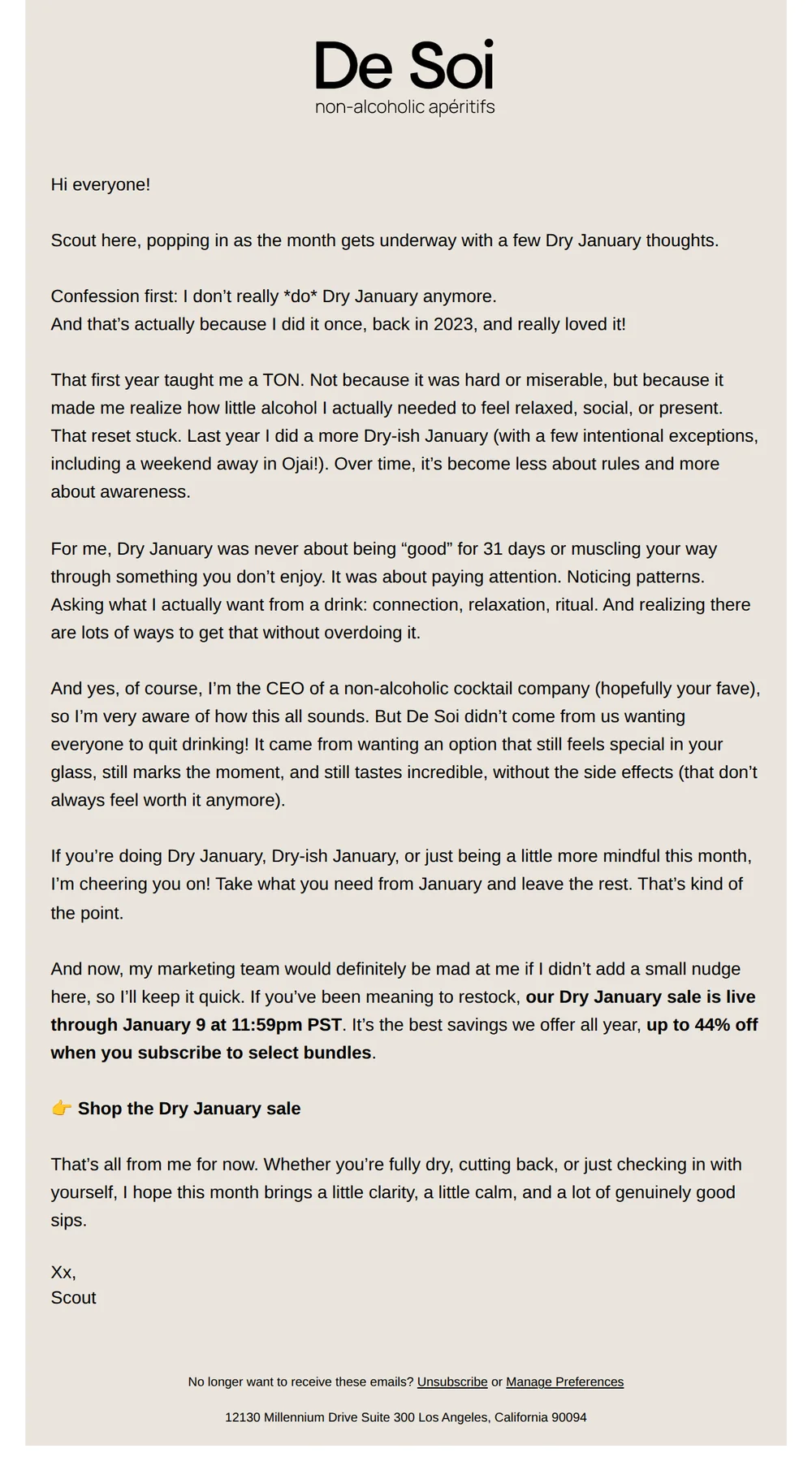
Confession: I don’t really do Dry January (and here’s why)
Pattern: CEO admits she doesn't do Dry January anymore.
Use it here: A candid point of view can make a founder-led message feel specific; it still needs to earn its product or offer claim in the body.
Open reference in new tab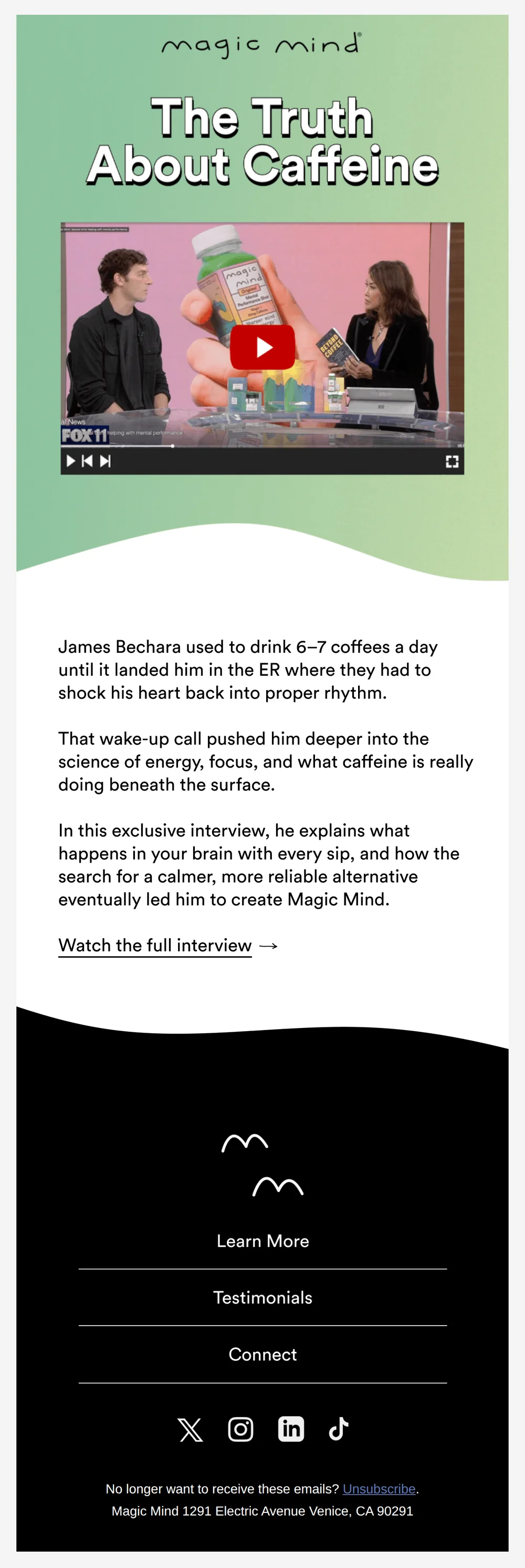
Magic Mind Founder Interview Reveals Truth About Caffeine
Pattern: Founder's caffeine ER scare led to Magic Mind.
Use it here: Use a genuine origin or problem to create a reason to read, then keep the copy grounded in facts the brand can support.
Open reference in new tabCreative and design curation only. These are role references, not reported revenue, conversion, or a promise that the exact tactic will transfer unchanged.
Need help implementing this?
We build and manage complete email & SMS programs for DTC brands. Get a custom plan for your brand.
Get Your Free Audit + Gameplan