Offers and CTAs That Convert
The offer is the reason people click. Learn how to structure offers beyond blanket discounts, and how to write CTAs that make the next step obvious.
- Write the message using the framework in this lesson
- Evaluate the copy against one clear customer action
Why does the offer matter more than the email design?
The offer gives the customer a reason to act; design makes that reason easier to understand. Neither is a universal substitute for the other. ZHS operating guidance is to define the customer value, inventory constraint, and margin before polishing the creative, then test the message against a clearly named action.
The offer is the reason someone may click; the design helps them understand it. Use the common offer categories below as a planning menu, and use one primary CTA as the ZHS default when an email has one conversion job. If secondary links are necessary, keep them visually subordinate and compare the outcome against a focused version instead of assuming either layout wins.
You have more than one lever, so do not default to discounts. Consider gifts, bundles, free shipping, early access, or a real restock before a code. For a focused conversion email, start with one primary CTA and name the outcome ("Get my prep checklist"), not the mechanic ("Submit"). Use urgency only when the scarcity is true. Treat discount eligibility and exclusivity as segment tests tied to margin and customer history, not permanent rules.
The CTA is how you make the next step obvious.
Some programs default to discounts without testing a full-margin alternative. Repeated, broad discounting can change customer expectations and pressure margin, so compare it with other offers before making it the default. There are several ways to drive sales without discounting when the product, inventory, and audience support them.
What types of email offers can you use besides discounts?
Common offer categories beyond discounts include gift with purchase, free shipping, bundles or kits, early access or limited drops, and value or education. Each can pull a different lever, from perceived value to reduced friction to exclusivity. Choose one that fits the product, inventory, and audience, then build the email around a hypothesis you can measure.
Pick the offer that fits the product and the moment, then build the email around it.
| Offer type | Candidate use case | Hypothesis to test |
|---|---|---|
| Discount / code | Clearing stock or a reactivation test | Whether price is the binding constraint |
| Gift with purchase | A value-add test with acceptable economics | Whether perceived value changes the decision |
| Free shipping | Shipping-friction hypothesis | Whether delivery cost is blocking checkout |
| Bundle / kit | A convenience or assortment hypothesis | Whether a curated combination increases perceived value |
| Early access / limited drop | Eligible or engaged audience | Whether verified access or scarcity earns attention |
| Value / education | High-consideration or new-category product | Whether product understanding is the missing step |
Start from the goal, then choose the offer with the clearest customer value and a measurable trade-off.
What types of email offers can you use besides discounts
- 01Goal: clear stock or re-engageDiscount code
Test whether price is the constraint, while protecting margin and excluding customers where a code adds no incremental value.
- 02Goal: raise AOVGift with purchase or bundle
Test a value-add instead of a price cut, and compare economics, attach rate, and customer response.
- 03Goal: remove checkout frictionFree shipping
Confirm that delivery cost is a material objection before using shipping as the offer.
- 04Goal: recognize an eligible audienceEarly access or limited drop
Use access or scarcity only when eligibility and availability are true, and document who qualifies.
- 05Goal: explain a considered purchaseValue and education
Teach the relevant outcome or use case, then test whether better understanding changes the next action.
Structured from the canonical article steps for responsive reading and presenter mode.
A restock or "final run" can support a full-margin campaign when its demand proof and deadline are verifiable. Pair it with a back-in-stock flow to notify people who explicitly asked to hear about availability. Do not imply scarcity when supply is not actually constrained; a full-margin offer is one option to test, not a promise that discounting is never needed.
For a post-purchase or win-back, the offer can even be help. A prep checklist that teaches the customer how to win with what they already bought.
Early access can be tested with eligible or engaged subscribers; a reactivation offer can be tested with a lapsed segment. Define the control group, margin guardrail, and exclusion rules first. Do not assume any audience needs a code just because it is cold, or that another audience would certainly have paid full price.
How should you structure your discount codes?
Choose code architecture based on attribution, abuse risk, and the commerce platform. A dedicated static code can be practical for a flow family when it is restricted appropriately and the team needs simple attribution; separate codes can make reporting and replacement easier. If the offer must be truly individual or tightly controlled, use platform-supported unique codes instead.
Do not present a static code as unique to a subscriber. A format such as BRAND-XXXXXX can be easier to recognize in support and reporting, but it is still a shared code unless the platform generates a distinct one for each person.
Shared codes reduce setup and replacement work; unique codes can reduce sharing and give cleaner individual attribution. Neither is categorically better. Document the chosen trade-off and test that the code, deep link, expiration, and reporting work in a non-production checkout before the flow goes live.
If the commerce-platform link is configured to auto-apply the code, say so clearly in the copy and verify it in a non-production checkout. If it is not configured that way, do not imply that the link does the work; give the customer the accurate redemption instruction.
A dedicated redeemed code can be one attribution signal when the order event reliably includes it. A team can evaluate a split such as "Placed Order where Discount Codes contains the welcome code" only after confirming the exact event properties, code behavior, and edge cases in its connected store. Do not treat a discount-code field as the sole purchaser or offer-attribution signal without that validation.
One practical setup is a dedicated code per flow family, for example, separate welcome and abandonment codes, when the commerce platform exposes reliable order properties. It can simplify reporting and replacement, but validate exclusions, stacking behavior, expiration, and attribution before treating the code as a definitive source of truth.
How many CTAs should an email have?
For a conversion-focused email, start with one primary CTA. It gives the reader a clear next step and gives the team a cleaner hypothesis to evaluate. Supporting navigation can still be appropriate; make it intentionally secondary, then compare focused and multi-link versions on the business outcome you care about rather than assuming more links always reduce clicks.
Stacking unrelated asks, "shop now," "read the blog," and "follow us", can make the intended action ambiguous and make attribution harder to interpret.
Decide the single action you want. Make that button the focal point. Let everything else support it.
- Reader can see the intended next step
- Design can emphasize one action
- Cleaner tracking for the primary hypothesis
- A clear hypothesis for the action that matters
- Reader may need to choose among unrelated actions
- Attention can split across links
- More ambiguous data when link purposes overlap
- More variables to interpret in reporting
What makes a good CTA button?
A good CTA names the result, not the mechanic. "Submit" tells the reader little; "Get my prep checklist" makes the next step more concrete. Lead with the outcome your product creates, keep the button and the line above it working together, and test whether the phrasing is understood by the intended segment.
Weak button copy names a mechanic. Strong button copy names the result.
"Submit" tells me nothing. "Get my prep checklist" tells me what I walk away with.
Lead with the outcome your product creates, the same way you write emails people actually read and lead with the promise up top.
| Before | After |
|---|---|
| Submit | Send me the guide |
| Learn More | See how it works |
| Click Here | Get my free audit |
| Shop | Grab it before it's gone |
| Sign Up | Get early access |
Keep the button copy and the line above it working together. The line sets up the promise, the button delivers it.
If the button says "Get early access," the sentence above it should make clear this drop is live now and stock is limited.
When should you use urgency in email?
Use urgency only when the scarcity is real: a limited drop, a pre-order window, or a genuine restock quantity. A restock can be framed with demand proof and a real deadline when both are supportable. Resetting countdown timers or repeatedly extending a supposed final deadline risks eroding trust.
Scarcity is a message constraint, not a substitute for customer value. If you say "back by popular demand," "one final run," or "gone for good," keep a record that supports the claim and make the deadline operationally real.
Fake countdown timers that reset every visit and repeated final notices can make future claims less credible.
Use urgency only when the constraint is real: a limited drop, a pre-order window, a genuine restock quantity. If nothing is actually scarce, sell the outcome and leave urgency out.
A code expiry is a fair deadline only when the code actually stops working at that time. Set the expiry in the platform first, then make the message match it. If the offer is ongoing, describe it as ongoing; do not manufacture a countdown. The specific reminder cadence should follow the customer journey, send history, and a documented test plan.

What are the most common offer and CTA mistakes?
Common mistakes include defaulting to a discount, stacking multiple CTAs, button copy that names the mechanic, fake urgency, mismatching an offer to a segment, and burying the CTA. Use the list as a QA pass: identify the email's job, define the audience and margin constraint, verify any deadline, then make the primary action easy to find.
- Defaulting to a discount. Compare a code with a gift, bundle, education, access, or shipping hypothesis before committing margin.
- Stacking multiple CTAs. Pick one primary action per email and make it the focal point.
- Button copy that names the mechanic. Write the outcome, "Get my checklist," not "Submit."
- Fake urgency. Only use deadlines and scarcity when the constraint is real, or your list learns to ignore you.
- Mismatched offer and segment. Define eligibility before sending. A winback flow that re-engages churned customers can be a useful place to test a code, but measure incrementality and margin rather than assuming price is the answer.
- Burying the CTA. Make the primary action easy to find, then test the hierarchy on the devices and inboxes your audience uses.
Get Expert Help
Our team builds full-margin offers and sharp CTAs into every email and SMS program we run, so your list stops waiting for the next promo.
Want us to look at your program and show you where the full-margin revenue is hiding? We will map it out with you.
More patterns to study
Curated creative references for this lesson. Study the mechanism, then adapt it to your own audience, offer, and evidence.
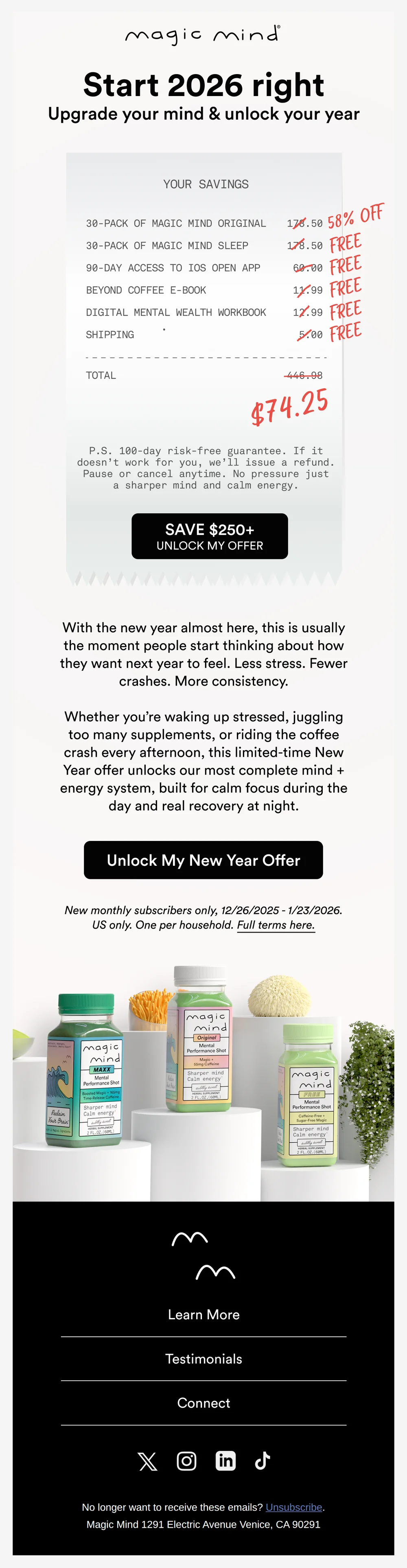
Start 2026 right
Pattern: Receipt visual shows $446 bundle for $74.
Use it here: Make bundle value concrete enough to understand at a glance, then verify the offer math, availability, and landing-page continuity.
Open reference in new tab
💰 Buy more sauce, save more
Pattern: Save more when you stock up on chili crisp.
Use it here: A stock-up CTA works when the customer can see why additional quantity is useful; do not use volume incentives without a margin rule.
Open reference in new tabCreative and design curation only. These are role references, not reported revenue, conversion, or a promise that the exact tactic will transfer unchanged.
Need help implementing this?
We build and manage complete email & SMS programs for DTC brands. Get a custom plan for your brand.
Get Your Free Audit + Gameplan