The BFCM & Holiday Email Playbook
Black Friday is won in October. Learn the ZHS pre-BFCM prep, send cadence, and deliverability moves that turn the biggest week of the year into your biggest.
- Plan the campaign using the framework in this lesson
- QA the offer, audience, creative, and measurement plan
Why is Black Friday won in October, not November?
Because peak-week execution is constrained by decisions you make before the send calendar exists: offer economics, inventory, consented audience quality, authentication, creative production, and ownership. Start the planning work early enough to test those inputs; the right lead time depends on your traffic, list health, and merchandising calendar.
This is a ZHS planning framework, not a universal send-count prescription. Establish the offer, audience, authentication, and measurement plan before peak volume; then set cadence from consent, prior response, and operational capacity. Use a different reason to buy across Black Friday, Cyber Monday, and the post-event window rather than escalating a discount by default.
In our operating experience, the teams that make these decisions before peak week have more room to QA, learn, and adapt. That does not guarantee a revenue result or inbox placement; it gives the program a controlled starting point instead of a last-minute blast plan.
Treat the pre-season period as a readiness cycle: verify the sending setup, examine audience engagement, choose offer mechanics, create the creative system, and assign owners for live monitoring. The November calendar should be an output of that work, not a substitute for it.
Rather watch than read? Here is the full BFCM breakdown.

What is the BFCM timeline, and when should each phase start?
The ZHS timeline uses four phases, each with a job. Pre-season prep runs through the end of October: authenticate, audit, re-engage, and build. October is warmup, testing, and VIP attention. November is execution, from teasers through last-chance extensions. December pivots to gifting and retention. Adjust the phase boundaries to the actual event date and your operational calendar.
What is the BFCM timeline, and when should each phase start
- 01Now through Oct 31Pre-season prep
Authenticate your domain, audit list health, re-engage, and build the segments and offers before the noise starts.
- 02OctoberWarmup, testing, VIP love
Run a VIP-only flash sale to reward early-access signups and test subject lines, offers, and buttons before it counts.
- 03NovemberExecution
Teasers, early access, Black Friday, Cyber Monday, last chance, and extensions. Volume goes up, segments stay tight.
- 04DecemberGifting and retention
Pivot to gifting, anchor around shipping cutoffs, promote gift cards, and win back everyone who did not buy.
Structured from the canonical article steps for responsive reading and presenter mode.
When should you stop running sales before Black Friday?
Do not apply a blanket sale blackout. Decide whether to protect price before BFCM by looking at margin, inventory, purchase cycle, prior promo response, and the promise you have already made to customers. If you run a pre-peak promotion, give it a distinct purpose instead of implying it is the season's best price.
Repeated sitewide discounts can teach people to wait, but that effect varies by category and audience. A new-product launch, inventory-specific offer, or value-led campaign may still be appropriate; document why it exists and how it differs from the BFCM promise.
Use the pre-peak period to grow permissioned audiences and establish expectations. Value-led content, product education, and preference capture can all help, but no format guarantees placement in a specific inbox tab.
How do you fix deliverability and list health before BFCM?
Before peak volume, verify sender authentication, audience consent, and engagement definitions. Use your own sending history and mailbox-provider signals to decide which cohorts are safe to expand; do not use a fixed recency window or a single click-rate cutoff as a universal rule.
Authenticate your sending domain with SPF, DKIM, and DMARC, then validate the configuration in the systems that actually send your mail. Review campaign engagement, complaints, bounces, acquisition source, and audience recency together. If the signal deteriorates, narrow the next audience and investigate the cause before increasing volume.
Use a clear re-permission or sunset sequence for inactive profiles, with language and timing that match your brand and consent policy. Suppress or stop marketing to profiles that remain inactive according to the policy you document.
Consider a preference-center campaign when you have enough information to act on frequency or interest choices. Build segments from confirmed preferences rather than assuming every subscriber wants the same peak-week cadence.
The goal is a permissioned, engaged audience that you can scale deliberately during a crowded inbox period.
Peak season is not permission to send every message to every profile. Start with the most engaged eligible audience, expand only when the response and complaint trend support it, and keep the suppression policy consistent with your consent and deliverability review.
How many BFCM offers should you run, and how do you map them?
Use the smallest number of offer moments that gives customers a clear reason to act without making the promotion incoherent. ZHS commonly maps early access, Black Friday, Cyber Monday, and a post-event message as distinct planning windows, then adapts or removes windows based on the brand's catalog and inventory.
While you clean, you grow.
Launch a teaser pop-up ("BFCM early access") plus an embedded form on a landing page, then promote it through a small, deliberate campaign sequence. Add early-access banners to the pre-purchase flows where the message is relevant, all driving to that landing page.
Invite SMS only through clear consent, and make early access an optional, well-explained perk.
Map each window to an audience, an offer mechanic, and a message angle.
| Window | Timing | Mechanic |
|---|---|---|
| Pre-BFCM early access | Before Black Friday | VIPs and early-access list first |
| Black Friday | Friday | Sitewide % off or tiered buy-more-save-more |
| Cyber Monday | Monday | Change it up: BOGO, bundles only, code ladder, or gift with purchase |
| Post-BFCM last chance | After the event | Final urgency for non-buyers |
Map offers to segments so people with the clearest relationship to the offer receive it first. If your engagement-tier segments are not built yet, define and validate them before peak sends.
Merchandise bundles with Shopify ABC analysis to move slow stock with real value instead of deeper discounts.
The number of windows is a planning choice, not a maturity badge. Add an offer only when it has a distinct audience, economic rationale, creative angle, and operational owner. More sends can amplify a good plan or accelerate fatigue; the calendar alone does not tell you which one will happen.
Do not surprise early buyers with a materially better version of the same offer unless the policy is explicit. Instead of automatically deepening a discount, consider changing the mechanic: bundles, gifts, tiering, or a category-specific offer can create a new reason to buy while protecting trust.
How many emails should you send during BFCM week?
Set peak-week email and SMS cadence from audience capacity, consent, prior engagement, and the strength of each message, not a universal send count. Increase only when the audience has a distinct reason to hear from you, and keep campaign and deliverability signals in the decision loop.
Use teasers to set expectations only when you can make a truthful, useful promise. Coordinate email and SMS so each channel adds context instead of simply duplicating the same interruption.
For what to send outside the core offer windows, see our guide to SMS campaigns that convert.
Here is what that teaser looks like in practice.
Early access opens tomorrow. If you want the full offer details first, join here: [link]
On the largest offer days, a launch, a differentiated follow-up, and a final reminder may each be justified for eligible audiences. Treat the following as an illustrative sequence, not an instruction to send every step to every subscriber.
An illustrative BFCM peak-day sequence
- 01Before launchExpectation-setting teaser
Use only when the message makes a truthful promise and the recipient is eligible for the offer.
- 02LaunchPrimary email
Make the offer, audience, and deadline clear.
- 03LaunchSMS support where consented
Use the channel for a distinct, concise message to eligible SMS subscribers.
- 04Follow-upNew angle or proof
Add information rather than repeating the launch copy.
- 05Decision windowTargeted reminder
Use the audience and message that warrant a further reminder; do not default to a resend.
- 06CloseTruthful deadline message
State a real deadline and switch the Cyber Monday mechanic only if it serves the customer.
A ZHS planning example. Choose, combine, or omit steps based on consent, engagement, inventory, and live response.
Peak days can support higher frequency for high-intent, eligible audiences, but they are not permission to ignore fatigue or consent. Suppress recent purchasers according to your offer policy and coordinate campaigns with active flows so people are not needlessly double-sent.
On non-peak days, rotate the job of the message: product education, a collection spotlight, new arrivals, problem-solution framing, or customer proof. A calendar with only discounts loses useful context quickly.
Use a last-chance message only where the deadline is real and the recipient remains eligible. A resend should be a controlled test with a fresh reason or angle, not a default daily operation.
Keep pop-ups on and matched to the current site offer, swapping creative from Black Friday to Cyber Monday to extensions. One trick for peak week: run a pop-up with NO email field at all. It is not there to capture, it is there to point people straight at the offer. Here is what we are doing on the site, shop now.
Should you update your email flows for BFCM?
Update pre-purchase flows when the live offer materially changes what a new subscriber, browser, cart owner, or checkout abandoner should hear. The goal is message continuity, not a blanket rule tied to revenue size.
Put the Black Friday or Cyber Monday offer into them so they promote the sale instead of ignoring it. Here is how.
- Build a universal header block with the current offer and drop it as the hero of the pre-purchase flows.
- Gate it with a conditional split. Use a random sample or date condition so only the people who should see the Black Friday version get it, and everyone after the event drops back to the regular flow.
- Review the time delays. Make sure a time-sensitive offer cannot outlive the offer window. Preserve enough time for the person to act, and return the flow to its normal logic as soon as the event ends.
Do this for the pre-purchase flows where the offer is relevant. Every active flow should match the offer that is live, and your abandoned cart recovery flow is often a useful place to review first during peak week.
How do you monitor BFCM sends and pivot to December?
Monitor campaign response, complaints, bounces, audience composition, and conversion throughout the event. If a signal deteriorates, narrow the next audience and investigate the message, offer, acquisition source, and technical setup before escalating volume.
Use trends and cohort comparisons rather than interpreting a single metric in isolation. Open data can be distorted by mailbox privacy features; clicks, complaints, bounces, conversions, and unsubscribes usually produce a more useful operating picture.
When December begins, pivot the message to gifting, bundles, or product availability where they are real. State shipping deadlines plainly, promote gift cards after appropriate cutoffs, and make any post-event extension explicit rather than manufacturing urgency.
After the event, review sending pressure and audience response before the next campaign cycle. A plainer format or value-led content can be a useful test, but neither is a universal repair tactic; choose the next message from the observed issue.
Then thank your customers, especially the people who spent the most with you. Launch a winback flow for non-buyers ("Saved something special for you") and send thank-you follow-ups to new buyers so the holiday spike turns into repeat revenue.
What are the most common BFCM email mistakes?
The costliest mistakes are beginning after critical decisions are due, running promotions without a rationale, and treating a crowded inbox period as permission to abandon audience discipline. The following operational failures are worth reviewing before the event.
- Starting after critical decisions are due. Begin the work in time to QA the offer, audience, assets, and technical setup.
- Using promotions without a price or inventory rationale. Explain what makes each pre-peak or peak offer distinct.
- Letting the send calendar replace a plan. Map audience, economics, owner, and success signal for every offer moment.
- Improving a later offer without an early-buyer policy. Protect trust by changing the mechanic or making the policy explicit.
- Skipping audience and sender-readiness review. Re-permission, suppress, or narrow based on documented engagement and consent policy.
- Treating the whole database as equally eligible. Expand by engaged cohort and monitor live response.
- Double-sending people in flows. Coordinate campaign exclusions with active lifecycle messages.
- Manufacturing last-chance urgency. Use reminders only for a real deadline and a still-eligible audience.
- Repeating the same reason to buy. Give Black Friday and Cyber Monday different, truthful angles when appropriate.
- Using SMS as a duplicate blast channel. Send only to consented subscribers when the channel adds distinct value.
What are good BFCM email benchmarks?
There is no universal BFCM send-count benchmark. ZHS evaluates readiness and live performance through authenticated sending, audience eligibility, campaign response, complaints, bounces, conversion, and the trend against the brand's own baseline. Use the canonical cards below as diagnostic context, then apply them to a consistent reporting definition.
| Readiness or signal | Operating question |
|---|---|
| Authentication | Is the exact sending setup verified before the event? |
| Audience eligibility | Which consented, engaged cohorts can safely receive each message? |
| Response trend | Is the next send earning enough attention and conversion to justify its audience? |
| Complaint and bounce trend | Is the program creating a sender-reputation risk that warrants narrowing or pausing? |
Get Expert Help
Our team builds the full BFCM plan for your brand. The pre-season list cleanup, the segment map, the design system, and the day-by-day send calendar that holds through peak week.
We run the deliverability monitoring and offer sequencing so the team can operate its largest sales week with more control.
Here is where to start.
More patterns to study
Curated creative references for this lesson. Study the mechanism, then adapt it to your own audience, offer, and evidence.

UP TO 40% OFF: CLOTHING MUST-HAVES
Pattern: Sand-sculpted SKIMS store unlocks 40% off clothing.
Use it here: A sale can still feel branded when the visual world supports the offer; make the dates, exclusions, and discount terms easy to verify.
Open reference in new tab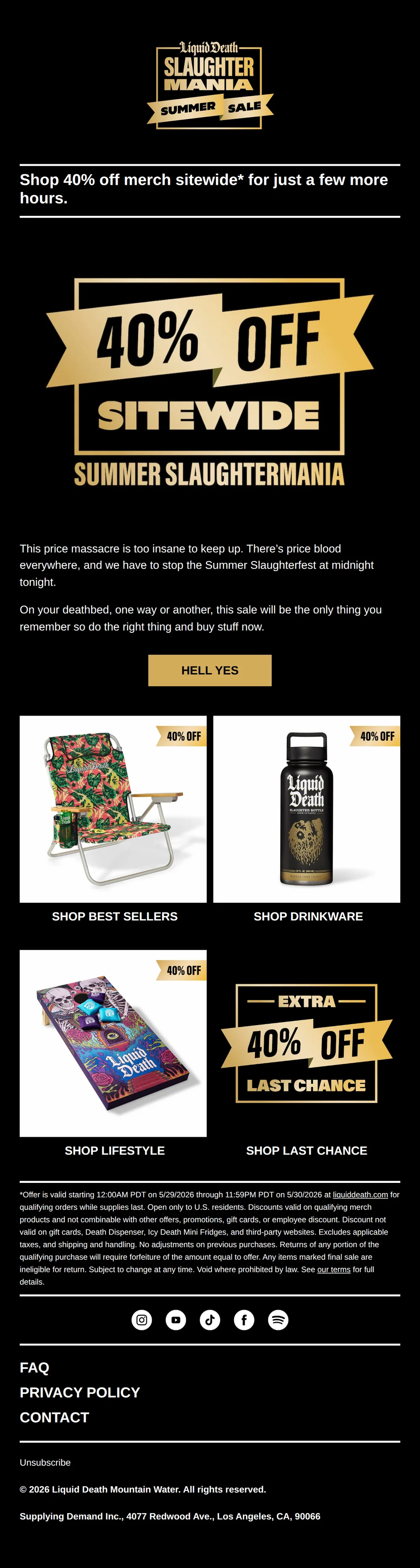
LAST CHANCE: 40% Off Ends Today
Pattern: Midnight deadline on 40% off sitewide sale.
Use it here: Reserve final-hours language for a genuine closing condition, and give the message one obvious action instead of competing promotion mechanics.
Open reference in new tabCreative and design curation only. These are role references, not reported revenue, conversion, or a promise that the exact tactic will transfer unchanged.
Need help implementing this?
We build and manage complete email & SMS programs for DTC brands. Get a custom plan for your brand.
Get Your Free Audit + Gameplan