Seasonal and Gifting Campaigns That Actually Convert
Plan seasonal, gifting, and moment-based campaigns that have a real customer and product reason to exist.
- Plan the campaign using the framework in this lesson
- QA the offer, audience, creative, and measurement plan
Why should you send seasonal and gifting email campaigns?
Seasonal and gifting campaigns can give a brand a timely reason to show up when the moment genuinely changes what customers need, buy, or give. They are not automatic revenue events: choose only moments that fit the product, audience, inventory, fulfillment promise, and brand voice, then evaluate the campaign against a documented baseline.
The hard part of campaign planning is finding a reason to contact someone that feels earned. A holiday, a customer routine, a product's real peak, or a verified delivery deadline can provide that reason, if the angle would still make sense without a generic sale banner.

Map the calendar once, but treat each potential moment as a hypothesis. In the ZHS operating view, a seasonal send needs a product-relevant angle, a defined audience, a feasible fulfillment promise, and a measurement plan. Gift guides, bundles, service, and free-value offers can be tested before a discount; do not assume a fixed campaign count or that every holiday deserves a send.
How do you plan seasonal campaigns for the whole year?
Create one planning calendar that separates major gifting events, lighter cultural or routine moments, and the seasons in which your product has a credible use case. Prioritize the moments with a clear customer job and enough lead time for creative, inventory, support, and fulfillment review.
Use three planning buckets.
- Major holidays. Gifting windows where the product solves a recognizable recipient or occasion need.
- Minor moments. A change of season, routine, or cultural moment that fits the brand without forcing a holiday graphic onto a normal promotion.
- Brand-relevant seasons. Periods when the product's actual use case becomes more salient, such as outdoor cooking for a food brand or routine shifts for a wellness brand.
The ZHS planning rule is to document why the moment matters, what the customer needs, who should receive it, what could block purchase, and how success will be measured. If you need help coordinating the overall rhythm, use the campaign cadence playbook; do not copy a send count from another brand.
| Planning period | Example moment | Campaign hypothesis |
|---|---|---|
| New-year routine | Reset or replenishment | Does the product support a credible routine change? |
| Gifting holiday | Recipient or budget guide | Can the guide make a gift decision easier? |
| Seasonal transition | Product-use shift | Does the product solve a new seasonal problem? |
| Brand peak | Category-relevant period | Is there inventory, support, and creative depth for the moment? |
| Delivery window | Verified service deadline | Can the promise be confirmed for the shopper's location? |
Why do gift guides convert so well?
Gift guides are a useful format to test because they organize products around a buyer's decision, such as recipient, use case, or budget. They do not convert by default; the guide must be relevant, easy to scan, stocked, and honest about what it can deliver.
When someone is buying a gift, the customer job is often to choose confidently and quickly. A guide can reduce choice overload by doing some of that organization for them.
Group products around an actual decision: a recipient, a product use case, or a price range that the brand can support. A secondary "for you too" angle may be worth testing when it is appropriate to the buyer and does not distract from the gift decision.
| Moment | Test angle |
|---|---|
| Valentine's Day | A recipient-led guide with a product-specific reason to give |
| Mother's Day | A guide organized around the recipient's routine or interests |
| Father's Day | Practical product use cases rather than a generic gendered message |
| Back to school | Routine or organization essentials that match the catalog |
| Seasonal transition | A curated collection tied to the changed use case |
| Winter holidays | Guides by recipient, use case, and available budget |
| Final verified delivery window | E-gift cards or digital options, only if the delivery claim is accurate |
What makes a seasonal email feel timely instead of forced?
A seasonal email feels timely when the occasion changes the customer's need and the product has a credible role in that change. It feels forced when the same promotion gets a holiday graphic with no product or customer connection.
The ZHS quality check is simple: remove the holiday name. If the campaign still has no reason to exist, it needs a more specific customer problem, product angle, or audience.
- A generic discount with no customer or product reason
- A promotion copied from a different category or brand
- A seasonal graphic pasted onto an unrelated template
- No connection between the moment and the product's use
- An unverified or last-minute fulfillment promise
- A guide or offer that solves a defined buyer problem
- An angle the brand can explain with real product context
- Design that stays recognizable while serving the moment
- A product framed around the changed use case
- A delivery or availability claim that operations has verified
You may not need a discount to make a seasonal campaign worth testing. A strong guide, a limited-edition bundle, a service promise, or a free-value offer can be viable when the value is clear and the economics are documented. See campaigns without discounts for additional structures.
How do you handle the shipping cutoff and last-minute shoppers?
Use a verified delivery cutoff while it is true, then change the campaign plan when it is no longer true. If the brand sells e-gift cards or another legitimate digital option, the post-cutoff message can offer that alternative without making a delivery promise the business cannot keep.
The cutoff should come from the fulfillment team, carrier/service data, inventory status, and destination, not a recycled calendar date. State the condition plainly, maintain the landing-page parity, and remove or update the message as soon as the promise changes.
How do you handle the shipping cutoff and last-minute shoppers
- 01Before the verified cutoffGuide and delivery reminder
Send the guide or recipient-specific recommendation only while the delivery statement is accurate for the audience and destination.
- 02Approaching the cutoffState the real condition
Use a clear, operations-approved deadline and make sure the landing page, support team, inventory, and campaign say the same thing.
- 03Physical delivery no longer qualifiesRemove the delivery promise
Stop using urgency that implies arrival by the occasion once the verified window has closed.
- 04Eligible digital optionOffer an appropriate alternative
If a real e-gift card or digital product is available, explain its delivery terms accurately and keep it separate from the expired physical-delivery claim.
A fulfillment-aware messaging sequence; verify the conditions with operations before each send.
What are the most common seasonal campaign mistakes?
The common mistakes are treating the calendar as a promotion machine, planning without operations, and using a generic sale in place of an actual customer reason to buy. A documented campaign brief prevents most of them.
- Planning only the biggest holiday. Review the full calendar, but activate only the moments with a credible product and customer fit.
- Sending before the campaign is ready. Give creative, inventory, support, and fulfillment teams enough time to verify the message.
- Defaulting to a discount. Test guides, bundles, service, or product education when those create clearer value and preserve the economics you need.
- Ignoring the product's real season. Use actual customer behavior and product context rather than a holiday trend that does not fit the catalog.
- Leaving an expired delivery claim live. Change the message when the promise changes; a digital alternative must be real and accurately described.
- Copying a seasonal graphic onto a normal promo. Make the angle specific to the buyer, product, and moment.
Get Expert Help
Our team builds a seasonal operating calendar, campaign briefs, gift-guide structures, and fulfillment-aware launch plans around the moments your catalog can credibly own. We align the creative, audience, offer, and measurement plan so each campaign can be evaluated rather than assumed to work.
More patterns to study
Curated creative references for this lesson. Study the mechanism, then adapt it to your own audience, offer, and evidence.

The Athletic Gift Guide
Pattern: No-think holiday gift guide for non-alcoholic beer.
Use it here: A seasonal gift guide works when it reduces an actual buying decision, not when seasonal imagery is the only new reason to send.
Open reference in new tab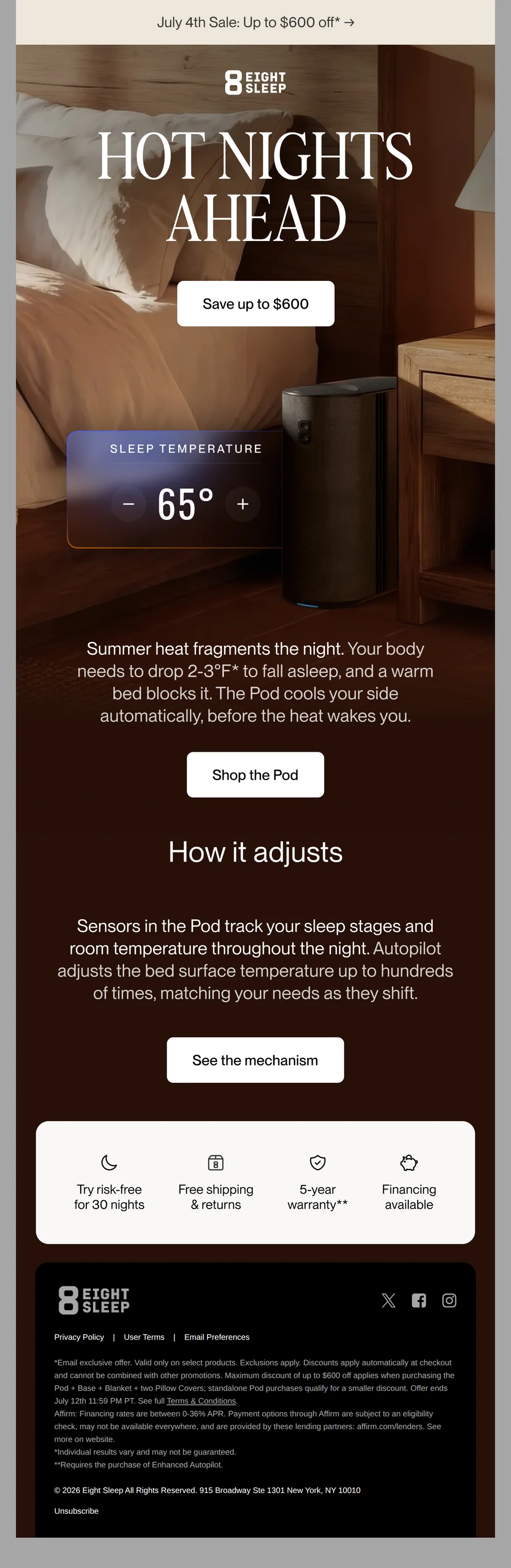
Hot nights ahead. Up to $600 off your Pod purchase*
Pattern: Summer heat ruins sleep — Pod fixes it automatically.
Use it here: Anchor a seasonal message in a concrete customer condition, then make sure the product and promotional claim are current for that audience.
Open reference in new tabCreative and design curation only. These are role references, not reported revenue, conversion, or a promise that the exact tactic will transfer unchanged.
Need help implementing this?
We build and manage complete email & SMS programs for DTC brands. Get a custom plan for your brand.
Get Your Free Audit + Gameplan